



Recent Post
- How to Build an AI Search Visibility Strategy for Your Personal Brand
- AI Search in 2026: How Businesses Can Build Visibility Beyond Google
- Unlocking Growth: AI SEO Consulting Case Studies and Insights
- Navigating the Future of AI Marketing Strategy
- Unlocking the AI SEO Expert Mindset: Strategies for Success
- Unlocking Success with an AI SEO Agency Blueprint
Indian businesses are no longer competing for visibility in just one search environment. A customer might Google a service, ask an AI assistant for recommendations, or use voice search for a direct answer. So, should a business invest in SEO, GEO or AEO in 2026? The practical answer is more nuanced: each solves a different part of the modern discovery journey.
For companies expanding across markets, even a best AI SEO specialist in US approach increasingly has to account for how search engines and generative systems interpret brands. For Indian businesses, the bigger challenge is deciding where these disciplines overlap, where they differ, and which deserves attention first.
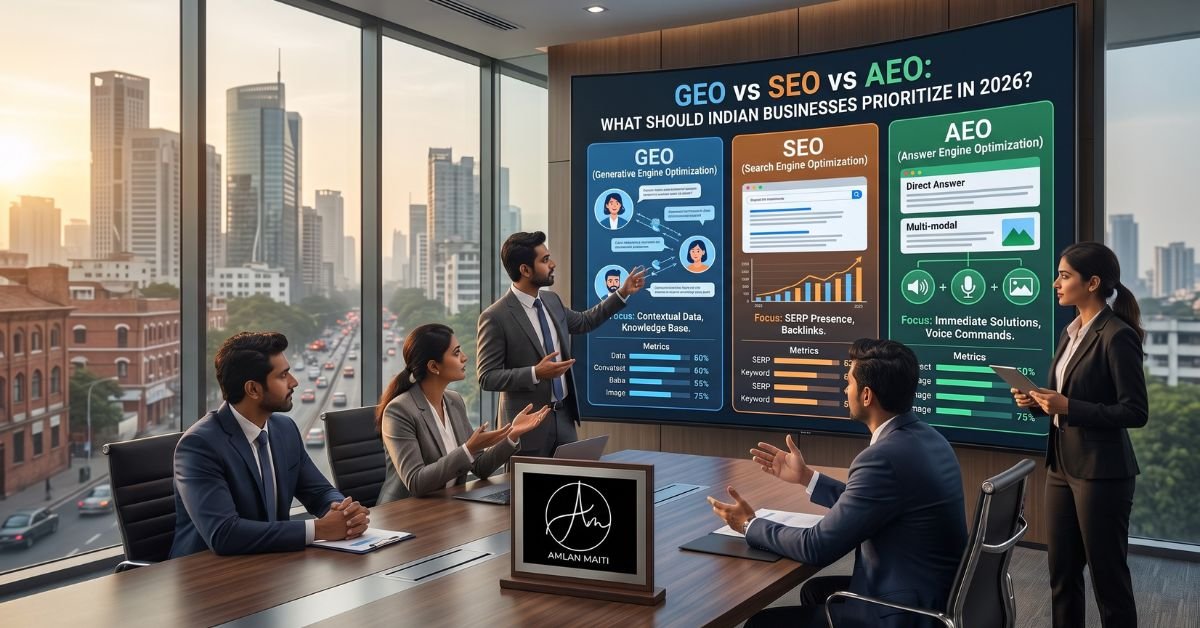
SEO, AEO and GEO: What Actually Changes?
The three acronyms can sound like different versions of the same thing. They are not.
SEO, or Search Engine Optimization, focuses on improving a website’s visibility in conventional search results. Technical accessibility, relevant content, internal linking, backlinks, page experience and search intent all remain part of that equation.
AEO, or Answer Engine Optimization, focuses more heavily on helping systems deliver direct answers to questions. It is particularly relevant when users want a concise response rather than a list of websites.
GEO, or Generative Engine Optimization, addresses visibility in generative search experiences, where AI systems synthesize information from multiple sources and produce conversational responses.
A simple way to visualize the difference is this:
- SEO asks: Can people find my page in search results?
- AEO asks: Can my information become a useful answer to a specific question?
- GEO asks: Can AI systems understand, trust and potentially reference my brand when generating an answer?
There is considerable overlap. That is important because businesses should not treat them as three completely separate marketing departments.
Why SEO Still Comes First for Most Businesses
There is a temptation in every new technology cycle to announce that the previous one is finished. Search marketing has seen this repeatedly. Yet the fundamentals tend to survive.
A technically broken website does not suddenly become healthy because it has been optimized for AI. A weak page does not become authoritative because someone adds a few conversational questions. And a business with inconsistent information across its website and public profiles will not magically become trustworthy to AI systems.
SEO provides much of the infrastructure on which the other strategies depend.
For an Indian business, that could mean making sure location pages are useful rather than duplicated, product information is complete, important pages are crawlable, site architecture makes sense and content genuinely addresses what customers are searching for.
Google’s own documentation continues to emphasize creating helpful, reliable, people-first content rather than content produced primarily to manipulate rankings. That principle is particularly relevant in an AI-driven search environment because content that lacks substance is unlikely to provide much value anywhere.
In practical terms, SEO should usually remain the foundation.
But SEO Alone No Longer Tells the Whole Story
Here is where things get interesting.
A business can rank well and still be less visible than expected during an AI-assisted buying journey.
Consider someone searching for “best accounting software for a growing manufacturing company in India.” The customer may not spend twenty minutes comparing ten blue links. They might ask an AI system to shortlist options based on GST compatibility, integrations, company size and budget.
The resulting answer could contain several brands, explanations and sources.
That is a fundamentally different discovery experience from scanning a conventional results page.
Research from Pew Research Center found that 58% of U.S. adults had encountered an AI-generated summary in Google search results as of March 2025. The study also observed that users were less likely to click traditional search-result links when an AI summary appeared. This is U.S. data, not an India-specific benchmark, but it illustrates the broader change in how search information can be consumed. Pew Research Center
For Indian brands targeting customers in India and overseas, this creates a second visibility layer beyond conventional rankings.
Where AEO Becomes Useful
AEO is particularly valuable when customers ask straightforward questions.
Think about queries such as:
- “What is the difference between GST and VAT?”
- “How much does website development cost in India?”
- “What documents are needed for an export business?”
- “How does a heat pump work?”
The user is not necessarily looking for a 2,000-word article. They want an understandable answer.
That changes how content should be structured.
Good AEO content tends to be direct
Put the answer near the beginning. Explain the context. Then expand where necessary.
For example, instead of writing six paragraphs before defining a concept, start with a concise explanation and follow it with examples, exceptions and practical implications.
Clear headings, descriptive subheadings, FAQs, concise definitions and logically structured information can make content easier for both people and information-retrieval systems to process.
But AEO should not become an excuse for writing every article like a dictionary.
Real customers have messy questions. They have constraints, doubts and follow-up concerns. The best answer-focused content addresses those nuances instead of producing artificially short responses.
Why GEO Is Getting More Attention in 2026
GEO enters the picture when the search experience becomes generative.
Instead of simply retrieving a page, an AI system may synthesize information from multiple sources and formulate an answer around the user’s intent.
That creates an important challenge for brands: being technically indexed is not necessarily the same thing as being meaningfully represented.
Suppose a user asks, “Which Indian digital marketing companies specialize in AI-driven search?” The system has to interpret the category, identify potentially relevant companies, compare information and construct an answer.
A company needs more than a service page to establish that it belongs in the conversation.
This is where concepts such as AI search optimization, entity consistency, topical authority, original research, expert authorship and third-party references become increasingly relevant.
GEO Is About More Than Adding AI Keywords
One of the easiest mistakes is to assume GEO means sprinkling phrases such as “AI search,” “generative search” and “ChatGPT optimization” throughout an article.
That is not a strategy. It is keyword stuffing wearing a futuristic jacket.
Generative systems need context. A brand’s identity, expertise, products, claims and supporting evidence should form a coherent picture across its digital presence.
For example, an Indian SaaS company could strengthen its GEO foundation by publishing:
- Original industry research that provides information others can reference.
- Expert-led guides that demonstrate genuine knowledge rather than generic summaries.
- Detailed product documentation that makes capabilities and limitations clear.
- Comparison and decision content that answers realistic buyer questions.
- Consistent company information across reputable business and industry sources.
The objective is not to trick an AI system into mentioning the company. It is to create a body of useful information that makes the company easier to understand and evaluate.
The Indian Market Makes the Decision More Interesting
India is not one uniform search market.
Businesses operate across English, Hindi and numerous regional languages. Customers may move between Google Search, YouTube, marketplaces, social platforms, WhatsApp conversations and AI tools during a single buying journey.
For local businesses, location can be equally important. “Best dentist” is very different from “best dentist near me in Pune.” A B2B manufacturer may have an entirely different discovery path from a D2C skincare brand.
This means there cannot be one universal SEO-AEO-GEO allocation for every Indian company.
A regional service business may need strong local SEO and answer-focused content. A technology company targeting international buyers may place greater emphasis on technical SEO, thought leadership and AI search visibility. An ecommerce brand might need strong product discovery, structured product information and content that answers comparison questions.
So, What Should Indian Businesses Prioritize?
Rather than choosing one acronym and abandoning the others, think in layers.
Layer 1: Build the SEO foundation
Start with technical health, crawlability, information architecture, search intent, useful content and trustworthy business information.
Layer 2: Make important information answer-ready
Identify the questions customers repeatedly ask. Provide concise answers, then add enough depth to make those answers genuinely useful.
Layer 3: Build generative-search authority
Create original material, demonstrate expertise, strengthen your digital footprint and monitor how AI systems describe your brand and category.
In other words, the priority is usually not SEO versus AEO versus GEO. It is SEO plus AEO plus GEO, applied in the right sequence and proportion.
A Practical 2026 Framework for Indian Businesses
If resources are limited, businesses can use a simple prioritization exercise.
- Audit traditional search: Identify important keywords, pages, technical weaknesses and conversion gaps.
- Map customer questions: Document informational, comparison and decision-stage questions.
- Test AI discovery: Ask relevant AI systems how they answer important category questions and which sources they reference.
- Find authority gaps: Look for topics where competitors are better represented or where your brand lacks credible supporting evidence.
- Measure business impact: Connect search visibility to qualified leads, sales conversations and revenue rather than vanity metrics alone.
This approach prevents businesses from chasing every new AI-search trend.
What About Voice Search and Conversational Search?
AEO becomes especially interesting as interfaces become more conversational.
Users increasingly phrase requests naturally rather than typing fragmented keywords. That does not mean every query is spoken into a smart speaker. It simply means search interfaces are becoming better at handling complete questions.
Content that understands natural language, context and follow-up questions can therefore be more useful than pages designed around awkward exact-match phrases.
For Indian brands, multilingual content creates another opportunity. Businesses serving diverse audiences can consider how customers actually phrase questions in English and relevant Indian languages rather than translating English keyword lists word for word.
How to Measure the Three Strategies
Measurement should follow the job each discipline is doing.
- SEO: Track organic visibility, qualified traffic, rankings, indexed pages and conversions.
- AEO: Monitor answer visibility, featured-answer opportunities, question coverage and engagement from informational searches.
- GEO: Track brand mentions, citations, inclusion in AI-generated recommendations and visibility for important conversational prompts.
AI visibility measurements should be interpreted carefully. Responses can vary by platform, model, query wording, location and timing. A single prompt test is not enough to establish a stable market position.
The better approach is to build a repeatable prompt set and monitor changes over time.
Final Thoughts
The SEO era is not disappearing overnight. Neither are AEO and GEO isolated replacements for it.
For Indian businesses, 2026 is better understood as a period of convergence. Search engines are becoming more conversational, answer systems are becoming more capable, and generative interfaces are changing how people discover brands.
The smartest response is not to chase whichever acronym happens to be trending this month. Build a strong search foundation, make your knowledge easy to extract and understand, and then build enough authority that AI systems have a reason to recognize your brand.
In the end, visibility is still about being useful. The interface has simply changed.
Related Articles
12 September 2026
How to Build an AI Search Visibility Strategy for Your Personal Brand
Personal branding used to mean showing up consistently on Google, LinkedIn and social media. That is no longer the whole…

14 May 2026
Mastering the RAG Content Audit Checklist: Trends, Tools, and Best Practices
Introduction In today’s digital landscape, conducting a RAG content audit is essential for businesses aiming to enhance their online presence…

04 May 2026
Building Trust in AI Agents: Strategies for Optimization
In the rapidly evolving landscape of artificial intelligence, AI SEO has become a crucial component for businesses looking to enhance…

Get In Touch
Initiate your digital marketing journey by filling out this form.