



Recent Post
- How AI Is Changing the Digital Marketing Funnel From Discovery to Conversion
- How AI Can Connect SEO, Paid Ads, CRO and Lead Generation
- How Multi-Agent AI Systems Could Reshape Performance Marketing
- Agentic AI Marketing: How Autonomous AI Agents Are Changing Digital Marketing
- Knowledge Graph SEO: Why Entities Matter in the Age of AI Search
- AI Discovery Index: A New Way to Think About Brand Visibility
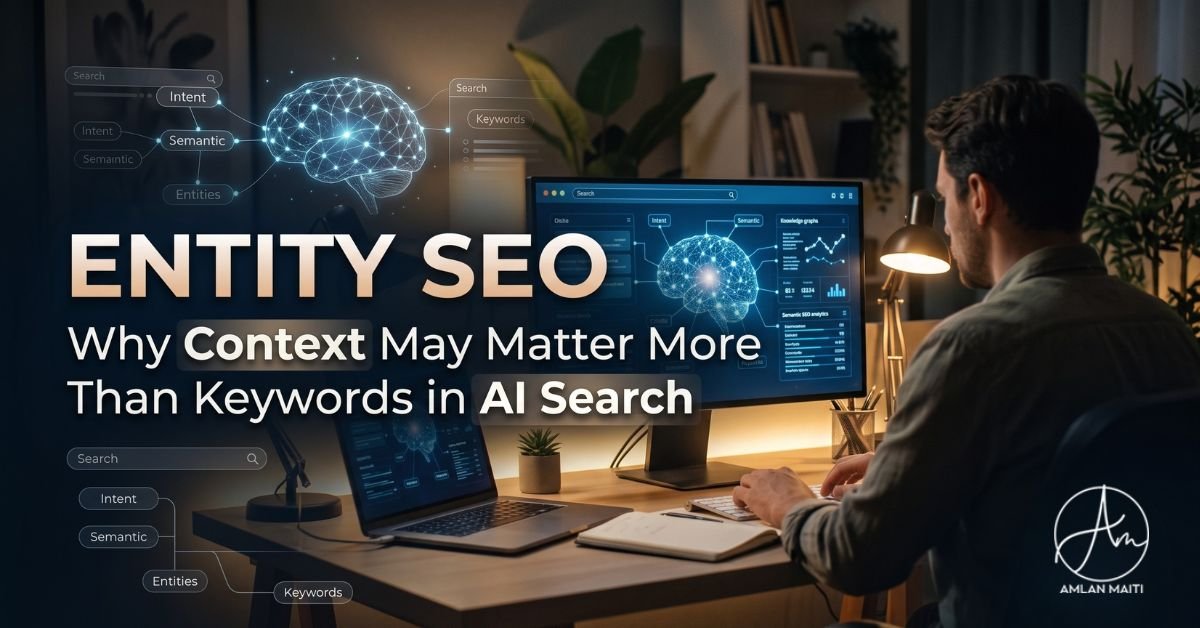
For years, SEO taught marketers to think in keywords. But AI search is changing the question. Instead of simply matching words on a page, modern search experiences increasingly need to understand what a business, product, person, or topic actually represents. In that environment, context can become the difference between being merely mentioned and being meaningfully understood.
That is why an AI SEO expert in United States needs to think beyond keyword placement. The bigger challenge is building a consistent digital identity that search systems can connect across websites, profiles, publications, reviews, and other sources.
Keywords Tell Search Engines What You Say
Entities help explain what you mean.
Consider a simple example. A website might repeatedly use the phrase “digital marketing company.” That tells a search engine something about the language on the page. But it does not necessarily explain which company it is, where it operates, what services it specializes in, who founded it, which industries it serves, or how credible its claims are.
Those details create context.
Think of keywords as labels on boxes in a warehouse. Useful, certainly. But if you want to find a particular box quickly, you also need information about its contents, location, relationships, and history.
That is broadly where entity SEO enters the picture.
What Exactly Is an Entity in SEO?
An entity is essentially a distinct, identifiable thing or concept: a company, person, place, product, organization, service, event, or subject.
For example, “Apple” could refer to a fruit, while Apple Inc. represents a specific company. Context helps distinguish the two.
Search engines have spent years becoming better at understanding these distinctions. AI-powered search makes that understanding even more important because generative systems need to assemble information from different sources and produce an answer that makes sense as a whole.
Google’s documentation explains that its systems work with entities and structured information to understand content and relationships. Its structured data documentation also explains how machine-readable information can help Google understand the meaning and relationships represented on a page.
The key point is easy to miss: structured data does not magically make a business authoritative. It simply gives search systems clearer information to work with.
Why Context Matters More in AI Search
Traditional search can often return a list of documents matching a query. Generative search has a different job.
It may need to understand the question, identify relevant concepts, retrieve information, compare sources, and construct a coherent response.
That makes context particularly valuable.
Suppose someone asks an AI search system:
“Which SEO companies specialize in helping Indian businesses improve visibility in AI search?”
A page that simply repeats “SEO company” twenty times is not necessarily the strongest candidate.
A more useful source might clearly establish:
- What the company does and where it operates.
- Which SEO and AI-search services it provides.
- Who its experts are and what experience they have.
- Which industries or business problems it addresses.
- How its services relate to SEO, GEO, content, technical optimization, and conversion.
The second page gives a search system a much richer picture.
This is one reason AI search optimization is increasingly about information architecture and consistency rather than simply inserting more keywords.
Entities Are Built Through Relationships
An entity rarely exists in isolation.
A company may be connected to its founder, headquarters, services, industry, products, publications, awards, customer reviews and professional profiles. Those relationships collectively strengthen the digital understanding of the entity.
Imagine trying to identify a person at a crowded conference.
The name alone may not be enough. But if someone tells you, “That’s Amlan, the founder of Digital Piloto, who works in AI-driven SEO and digital marketing,” the identification becomes much easier.
Search systems work with similar contextual signals, although their underlying processes are considerably more complex.
This means businesses should aim for consistency across important digital touchpoints.
Look for consistency across:
- Official websites and About pages.
- Professional author and company profiles.
- Business listings and reputable directories.
- Industry publications and third-party references.
- Relevant reviews, mentions, interviews, and citations.
The goal is not to manufacture mentions everywhere. In fact, indiscriminate profile creation can create more noise than authority. The better approach is to make the important facts about the entity accurate, useful, and consistent.
Content Needs to Explain Relationships, Not Just Topics
One of the easiest ways to apply entity SEO is to rethink content planning.
Instead of creating an article simply because a keyword has search volume, ask what concepts should be connected around that topic.
For example, a company writing about “technical SEO” might naturally cover crawling, indexing, structured data, JavaScript rendering, Core Web Vitals, internal linking and search accessibility.
Those concepts create a semantic neighbourhood.
Likewise, an article about “AI search optimization” could naturally discuss retrieval, citations, entities, brand mentions, generative search, content quality and user intent.
This does not mean stuffing every related phrase into one article. Quite the opposite.
Good entity-focused content feels like a knowledgeable person explaining a subject thoroughly. The relationships appear naturally because they are genuinely relevant.
Structured Data Helps, But It Is Not the Whole Strategy
Structured data is often discussed as if adding Schema markup automatically improves rankings.
That is too simplistic.
Schema can help search engines interpret certain information, particularly where supported structured-data types exist. Google notes that structured data gives explicit clues about the meaning of a page and can make content eligible for particular search features.
But markup should support information that is genuinely present on the page. It should not be treated as a shortcut around weak content, poor reputation, or unclear business information.
A useful entity strategy therefore combines machine-readable information with human-readable evidence.
How to Strengthen Your Entity Signals
Businesses can start with a relatively simple process.
- Define the entity: Clearly explain who you are, what you offer, where you operate, and who you serve.
- Build consistent references: Keep important business and expert information aligned across credible platforms.
- Connect related concepts: Create content that naturally explains your services, expertise, industries, products, and customer problems.
- Use appropriate structured data: Implement supported Schema types accurately and keep them consistent with visible page content.
- Earn third-party validation: Seek genuine mentions, citations, reviews, interviews, and industry references rather than manufacturing them.
This approach creates something much more durable than a page optimized around one keyword.
AI Search Rewards Clarity, Not Just Repetition
There is an important philosophical shift here.
Keyword SEO often encouraged marketers to ask, “How many times should I use this phrase?” Entity-focused SEO encourages a better question: “What would a search system need to know to understand this subject correctly?”
That change can improve content for humans too.
A reader does not want to see the same phrase repeated ten times. They want to understand what a company does, why it is relevant, whether its claims are credible, and how it differs from alternatives.
AI search has effectively made that distinction more visible.
Where E-E-A-T Fits Into Entity SEO
Context is not only about factual relationships. It is also about credibility.
Google’s Search quality guidance emphasizes experience, expertise, authoritativeness, and trustworthiness—commonly summarized as E-E-A-T—as important concepts for evaluating the quality of content. Google’s helpful content guidance similarly encourages original, useful content created primarily to help people.
For businesses, this means an entity strategy should include real expertise signals.
Show who is behind the company. Explain relevant experience. Cite credible sources when making factual claims. Publish original insights. Keep service descriptions specific. Make it easy for users—and search systems—to understand why the organization is qualified to discuss its subject.
In other words, entity SEO is partly technical and partly editorial.
What Marketers Should Stop Doing
As AI search evolves, several old habits deserve a second look:
- Creating separate pages for every tiny keyword variation without adding meaningful value.
- Repeating the same company description across dozens of low-quality websites.
- Adding Schema markup that does not accurately represent visible content.
- Writing broad AI-generated articles without demonstrating genuine expertise.
- Measuring success only through traditional keyword rankings.
Rankings remain useful. Keywords remain useful too. The mistake is treating either as the complete definition of search visibility.
Frequently Asked Questions
What is entity SEO?
Entity SEO is an approach focused on helping search engines understand distinct entities and the relationships between them. It combines clear content, consistent business information, relevant references, structured data, and topical context.
Are keywords still important for AI search?
Yes. Keywords remain useful because they help express search intent and topic relevance. However, modern AI search can benefit from broader context, relationships, meaning, and trustworthy supporting information rather than keyword repetition alone.
Does Schema markup improve entity SEO?
Schema markup can help search engines interpret information when an appropriate structured-data type is supported and implemented correctly. It should complement useful content rather than replace it.
How can a small business improve its entity visibility?
Start with consistent business information, a detailed About page, clear service descriptions, credible author information, relevant third-party references, useful topical content, and accurate structured data where appropriate.
Final Thoughts
SEO is gradually moving from a world of isolated words toward a world of connected meaning.
Keywords still open the door, but context helps search systems understand what they are looking at once the door is open. For businesses competing in AI search, that distinction matters.
The strongest strategy is not to abandon keywords. It is to put them in their proper place—inside a larger, clearer picture of who you are, what you know, what you offer, and why your information deserves to be trusted.
Blog Development Credit
This article was conceptualized by Amlan Maiti, researched and developed with ChatGPT, Google Gemini and Copilot, then refined with SEO enhancements by Digital Piloto Private Limited.
Related Articles

04 October 2026
How AI Is Changing the Digital Marketing Funnel From Discovery to Conversion
The old marketing funnel was fairly predictable: attract attention, build interest, encourage consideration, and eventually convert. AI is making that…

03 October 2026
How AI Can Connect SEO, Paid Ads, CRO and Lead Generation
SEO brings people in. Paid ads create immediate opportunities. CRO tries to turn those visits into action, while lead generation…

02 October 2026
How Multi-Agent AI Systems Could Reshape Performance Marketing
Performance marketing has always been about coordination: media buyers, analysts, creative teams and marketers watching the same funnel from different…

Get In Touch
Initiate your digital marketing journey by filling out this form.