



Recent Post
- AI Citations vs Google Rankings: Understanding the New Search Visibility Model
- How Generative Engines Decide Which Brands to Mention
- From Search Rankings to AI Recommendations: The New Era of Digital Visibility
- Generative Discovery: How AI Is Rewriting the Digital Marketing Funnel
- How to Build an AI Search Visibility Strategy for Your Personal Brand
- GEO vs SEO vs AEO: What Should Indian Businesses Prioritize in 2026?
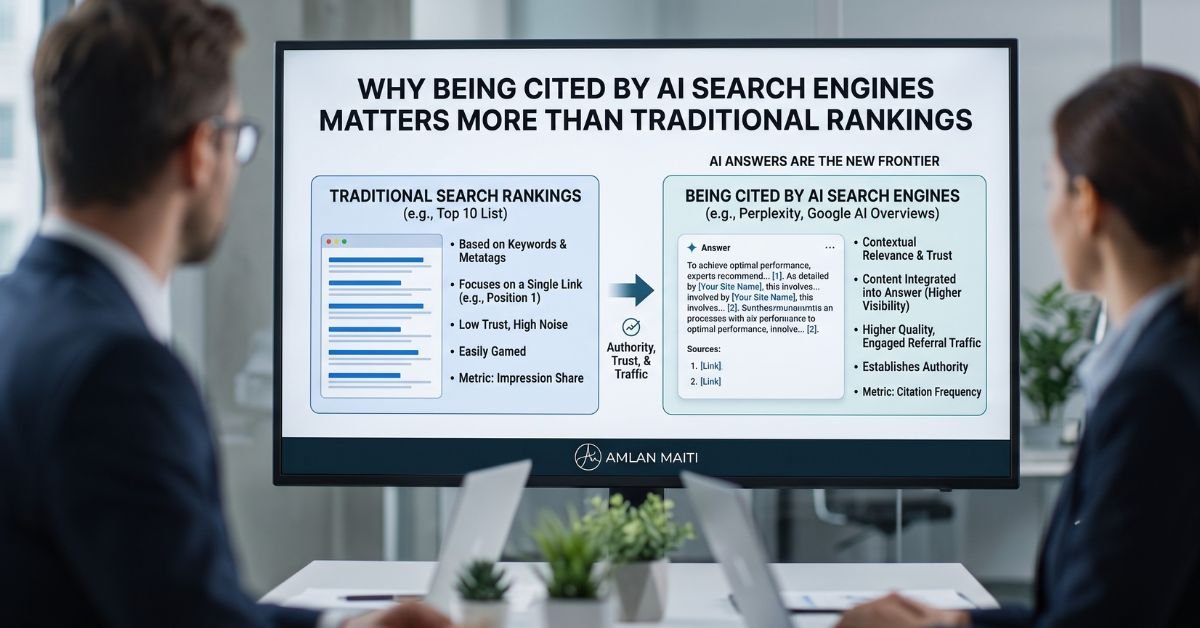
For years, a first-page Google ranking was the clearest proof that a brand had won search. But AI search is changing the scoreboard. Today, a brand can appear inside an answer, be referenced as a source, and influence a decision before a user ever scans a traditional results page. So, is being cited becoming the more meaningful form of search visibility?
That question is becoming increasingly relevant for businesses working with an AI SEO Specialist in Singapore. Traditional rankings still matter, but AI-powered discovery introduces another layer: whether your content is understood well enough to become part of the answer itself.
Rankings and Citations Do Different Jobs
A traditional ranking tells you where a page appears among competing search results. It is measurable, familiar, and still valuable. But it mainly describes your position on a results page.
An AI citation tells a slightly different story.
Imagine someone asks an AI search engine, “What should a small ecommerce company check before investing more money in SEO?” Instead of returning a list of pages, the system may explain technical problems, content gaps, measurement issues, and conversion considerations in one response. Several websites can then be cited as supporting sources.
If your page is one of those sources, your information has moved from being a result the user might inspect to being evidence used within the answer.
That is a subtle but important difference.
A ranking competes for attention. A citation can become part of the information experience.
AI Search Is Changing How People Discover Information
Search is becoming more conversational, especially for complicated questions. Users do not always want ten separate pages to read. Increasingly, they want a synthesized starting point and then the ability to explore the sources behind it.
Google reported in May 2025 that AI Overviews had expanded to more than 200 countries and territories and more than 40 languages. Google also said that, in major markets such as the United States and India, AI Overviews were associated with more than a 10% increase in usage for the types of queries that trigger the feature. Google’s official announcement provides the relevant rollout details.
Google’s I/O 2025 presentation also reported that early AI Mode testers were asking queries roughly two to three times longer than traditional searches. Longer queries often contain more context, constraints, and follow-up intent, giving AI systems more information to interpret. Google’s I/O 2025 announcement documents this observation.
This matters because longer, conversational searches create more opportunities for content to be retrieved for a specific question rather than simply ranked for a short keyword.
Why an AI Citation Can Be Valuable
1. It puts your brand inside the answer
Traditional search usually requires the user to choose a result first. AI search can reverse that sequence. The system may summarize the subject and then provide links to supporting sources.
That means your brand can become part of the user’s research before the user has consciously decided which website to visit.
For example, a person researching cybersecurity software may ask an AI system to compare features, pricing considerations, deployment models, and security requirements. A company whose content clearly explains one of those areas may be cited during the conversation.
The citation can therefore create an association between the brand and a particular area of expertise.
2. It can reinforce source visibility
A citation gives the user a path to the original material. This is particularly important when an answer contains technical information, statistics, product details, or recommendations that deserve deeper investigation.
OpenAI’s publisher guidance states that public websites can appear in ChatGPT search and explains that publishers should allow OAI-SearchBot access if they want content to be discoverable, surfaced, cited, and linked. OpenAI’s publisher guidance explains these controls and requirements.
In other words, discoverability is becoming a technical as well as editorial consideration.
3. It connects content with intent
A ranking may tell you that a page performs for a keyword. A citation can reveal that a piece of content is relevant to a particular question or concept.
That difference is useful for AI search visibility. A company should not only ask, “Which keywords do we rank for?” It should also ask, “Which questions do we have enough expertise to answer convincingly?”
The Data Shows Why This Shift Deserves Attention
A July 2025 Pew Research Center study offers an interesting glimpse into how AI-generated summaries were affecting Google search behaviour in the United States. Researchers examined 68,879 Google searches from a browsing panel of 900 adults and found that about 18% of searches in their March 2025 dataset produced an AI summary. The study is specifically a U.S. measurement from that period, not a universal estimate for every search engine or market.
The same research found that users clicked a traditional search result in 8% of visits when an AI summary appeared, compared with 15% when no AI summary appeared. Direct clicks on links within the AI summaries occurred in about 1% of visits. Pew Research Center’s analysis provides the methodology and limitations.
There is an especially interesting detail here: AI summaries appeared more often for longer searches. Only 8% of one- or two-word searches in the study generated a summary, compared with 53% of searches containing ten or more words.
So the growth of conversational search is not simply about changing where websites appear. It is also about changing the questions that content needs to answer.
What Makes Content More Citation-Worthy?
There is no magic formula that guarantees an AI system will cite a page. Different systems use different retrieval methods, indexes, ranking signals, and models. Their behaviour can also change.
Still, some fundamentals make content more useful to both search engines and people.
- Specific answers: Address important questions directly instead of hiding the answer beneath generic introductions.
- Original information: First-hand observations, research, examples, data, and practical experience give content substance.
- Strong evidence: Support important claims with credible sources rather than unsupported statements.
- Clear topical context: Explain concepts, relationships, definitions, use cases, and limitations.
- Technical accessibility: Make sure important content can be crawled, rendered, indexed, and understood.
Think of it this way: if an AI system has to extract a useful answer from your page, you want to give it clean ingredients rather than a pantry full of unlabeled jars.
AI Search Rewards Depth, Not Just Keyword Coverage
One common SEO habit is to create content around a keyword and then build the article outward from it. That approach can still work, but AI search makes semantic depth more important.
Suppose a company publishes an article titled “Best SEO Strategies.” It might mention technical SEO, content marketing, backlinks, analytics, and local SEO.
Now imagine another article that explains when technical SEO should take priority, how indexing problems affect organic discovery, why some pages receive impressions without generating leads, and which technical checks should be performed before increasing content production.
The second resource answers more meaningful questions.
It also gives AI systems more concrete information to retrieve.
This is where generative search optimization and conventional SEO increasingly overlap. The objective is not merely to insert relevant terms. It is to build a useful information resource that clearly demonstrates what the business understands.
Brand Authority Is Becoming More Distributed
There is another reason citations matter: AI systems can encounter information about a brand in many places.
Your website is important, but it is not necessarily the only source of context. Search systems may encounter company information through industry publications, professional profiles, reviews, research papers, videos, business directories, news coverage, and other publicly accessible sources.
That makes brand authority in AI search a broader concept than simply having a strong domain.
If a business claims to be an expert in a particular subject but publishes little useful evidence around that subject, the claim has limited informational depth. Conversely, a brand that consistently produces detailed resources, contributes useful information, and maintains a coherent digital presence gives search systems more context to connect.
What Businesses Should Measure Beyond Rankings
None of this means abandoning traditional SEO reporting. Rankings, impressions, organic visits, engagement, and conversions remain useful measurements.
But an AI-focused strategy can add another layer of observation.
- Track relevant AI questions: Monitor important customer questions rather than only short keyword phrases.
- Record citations and mentions: Identify when your pages or brand appear as sources in relevant AI answers.
- Study the cited pages: Look for patterns in which content earns references and what information those pages provide.
- Compare content gaps: Identify important questions competitors or other authoritative sources answer that your site does not.
- Connect visibility to business outcomes: Where possible, compare AI-driven discovery with branded searches, qualified visits, enquiries, and conversions.
AI visibility measurement is still developing, so the data should be interpreted carefully. A single AI response is not a reliable performance benchmark. Repeated observation across queries, locations, dates, and platforms gives a more useful picture.
Do Traditional Rankings Still Matter?
Absolutely. The more accurate view is that rankings and citations represent different layers of modern search visibility.
A strong organic presence can improve the likelihood that your content is discovered in the broader search ecosystem. At the same time, technically accessible, authoritative, well-structured content can create opportunities for retrieval and citation in AI-powered experiences.
It is less a case of replacing SEO and more a case of extending what SEO is designed to accomplish.
OpenAI’s description of ChatGPT search similarly emphasizes connecting users with original web content through source links. Its search experience is designed to provide answers while allowing people to inspect the underlying sources. OpenAI’s official introduction to ChatGPT search describes this source-oriented approach.
How to Build a Citation-Ready Content Strategy
A practical strategy starts with your customer’s questions rather than your publishing calendar.
Identify the questions people ask before choosing a product, hiring a service, comparing providers, or solving a problem. Then map those questions to pages that can answer them with real expertise.
The strongest resources often contain:
- A direct answer near the beginning
- Useful definitions and explanations
- Original examples or observations
- Relevant supporting evidence
- Clear headings and logical relationships between topics
- Links to deeper resources and related pages
- Transparent authorship and business information
This approach also improves the human experience. And that is worth remembering. Content created solely to satisfy an algorithm tends to become brittle. Content created to genuinely answer difficult questions has a better chance of remaining useful as search technology changes.
Frequently Asked Questions
Are AI citations replacing traditional rankings?
No. Traditional rankings remain an important part of SEO. AI citations add another form of visibility in which a website can be referenced within an AI-generated answer. Businesses can monitor both rather than treating either metric as a complete picture of search performance.
Why are AI citations important for businesses?
AI citations can place a business’s content directly within a user’s research journey. When a source is linked or referenced, the user has an opportunity to investigate the original page and learn more about the brand’s expertise.
How can a website increase its chances of being cited?
Publish useful, specific, well-supported information; maintain strong technical accessibility; organize content clearly; demonstrate genuine expertise; and provide original insights. No technique guarantees citation because AI systems use changing retrieval and ranking processes.
Should SEO teams stop focusing on keywords?
No. Keywords remain useful for understanding search demand and content topics. However, SEO teams should increasingly combine keyword research with question research, semantic relationships, entity context, user intent, and the information users need throughout the decision journey.
Final Thoughts
The old search question was simple: “Where do we rank?” The new question is more interesting: “When someone asks an AI system about our subject, does our information deserve to be part of the answer?”
That does not make rankings obsolete. It makes search visibility bigger than rankings.
Brands that invest in technically accessible websites, genuinely useful content, credible evidence, and clear topical authority can prepare for a search environment where being referenced may matter just as much as being found.
Blog Development Credit
Conceptualized by Amlan Maiti, this article was researched and developed with advanced AI tools, then refined and optimized for search by Digital Piloto Private Limited.
Related Articles
22 September 2026
AI Citations vs Google Rankings: Understanding the New Search Visibility Model
For years, search visibility meant chasing rankings: position one, featured snippets, more clicks. But AI-powered search is adding another layer,…

20 September 2026
How Generative Engines Decide Which Brands to Mention
Search is no longer just a list of blue links. Generative engines increasingly interpret questions, compare sources, and assemble answers…
18 September 2026
From Search Rankings to AI Recommendations: The New Era of Digital Visibility
For years, digital visibility had a familiar scoreboard: rankings, impressions, clicks, and traffic. But AI-powered search is changing what it…

Get In Touch
Initiate your digital marketing journey by filling out this form.