



Recent Post
- How to Monitor Brand Mentions in AI-Generated Answers
- Enhancing Marketing ROI Through Intelligent Customer Segmentation
- The Evolution of Business Automation: From Workflows to AI Agents
- Transforming SaaS with Structured Data and Intelligent Systems
- Adapting to AI Search: Publisher KPIs That Matter in 2027
- Quantum SEO Strategies to Improve AI Answer Inclusion in 2027
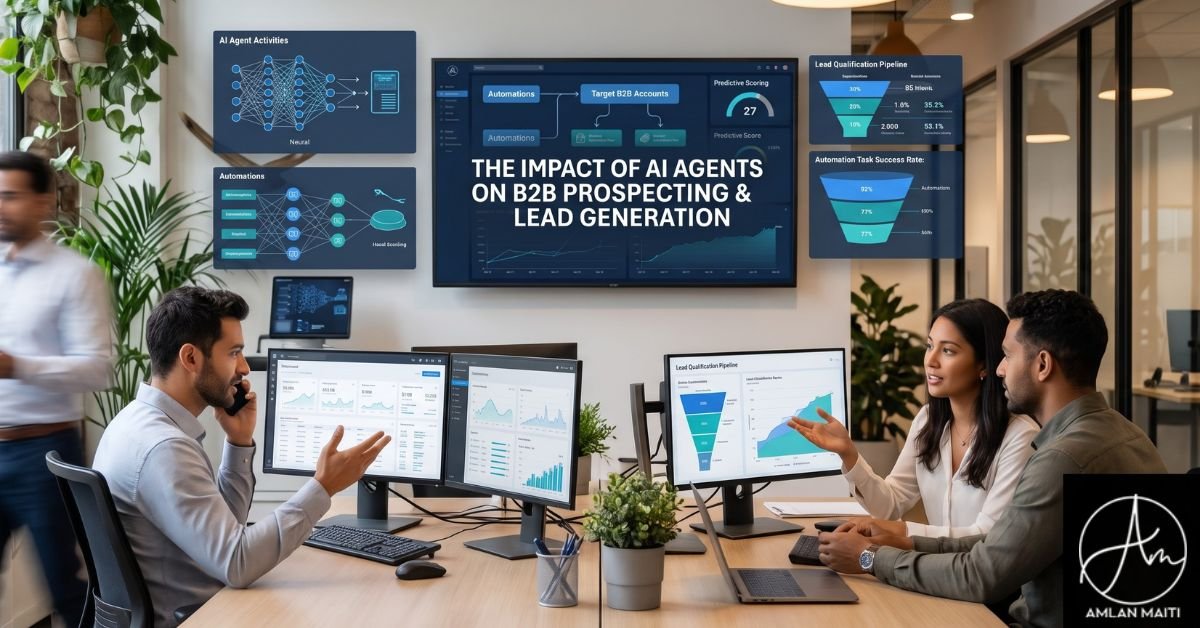
Finding the right business prospect has never been just a numbers game. Sales teams can contact hundreds of companies and still struggle to reach decision-makers who genuinely need their solutions. AI agents are beginning to change that equation. By combining research, data analysis, and intelligent actions, they are reshaping how B2B businesses identify opportunities and generate qualified leads.
For companies competing in increasingly crowded markets, effective prospecting requires more than collecting email addresses. It means understanding a potential buyer’s business, recognising buying signals, and starting relevant conversations. Whether an organisation is expanding internationally or consulting an AI SEO expert in South Korea, intelligent automation can support a more focused approach to business growth.
Why Traditional B2B Prospecting Needs a Rethink
Traditional B2B prospecting often involves a familiar routine: build a contact list, research companies, find decision-makers, send outreach messages, and follow up. It works, but the process can consume a surprising amount of time.
Sales representatives may spend hours switching between company websites, LinkedIn profiles, CRM records, and spreadsheets. By the time they finish researching a prospect, some of the information may already be outdated.
There is another problem. A large contact database does not necessarily represent a strong pipeline. A company might match an ideal industry profile but have no current requirement, budget, or intention to purchase.
This is where AI-powered lead generation offers a different perspective. Rather than simply increasing outreach volume, businesses can use intelligent systems to improve prospect selection and prioritise meaningful opportunities.
What Makes AI Agents Different from Traditional Sales Automation?
Traditional sales automation usually follows predefined rules. For example, when someone downloads a product brochure, the system might add that person to a follow-up email sequence. The workflow is useful, but its actions are largely determined in advance.
AI agents can work towards a broader objective. Depending on their tools and permissions, they can gather information, interpret context, recommend next steps, and coordinate multiple activities.
Imagine asking an AI agent to identify potential manufacturing clients in a particular region. Instead of returning a basic company list, it could research businesses, examine their services, look for relevant expansion announcements, compare them with an ideal customer profile, and prepare a prioritised prospect summary.
The agent is not simply moving data from one application to another. It is helping the sales team understand which opportunities may deserve attention.
How AI Agents Transform B2B Prospecting
1. Finding prospects that match the ideal customer profile
Successful B2B sales often begin with a clearly defined ideal customer profile (ICP). It may include company size, industry, location, revenue range, technology requirements, and business challenges.
AI agents can use these criteria to analyse prospect information and identify businesses that appear to fit. They can also compare multiple data points instead of relying on a single characteristic.
For example, a software provider targeting mid-sized logistics companies might prioritise businesses with complex delivery operations, expanding service areas, or visible investments in digital infrastructure. These indicators do not guarantee buying intent, but they can help narrow the research process.
2. Researching companies and decision-makers
Finding a suitable company is only the beginning. Sales representatives still need to understand who influences purchasing decisions and what matters to those individuals.
With access to approved information sources, AI agents can help prepare company summaries, identify relevant job roles, review public business announcements, and organise available contact information.
This reduces the time spent on repetitive research. It also gives sales professionals a useful starting point for conversations that feel informed rather than generic.
3. Recognising buying signals
Timing matters in B2B sales. A company hiring for a new department, entering another market, adopting new technology, or announcing an expansion may be facing requirements that create opportunities for service providers.
AI agents can monitor selected public signals and help sales teams identify developments worth investigating. A hiring announcement, for instance, might indicate operational growth. A new regional office could suggest a need for additional technology, logistics, or marketing support.
These are indicators, not proof of purchase intent. Human review helps distinguish a genuine opportunity from an interesting but irrelevant company update.
Making Lead Generation More Personal
One of the biggest weaknesses of mass outreach is that it often treats every prospect as though they have the same priorities. A finance director, operations manager, and technology leader may work at the same company, but their concerns can be very different.
AI agents can help sales teams adapt communication to the prospect’s role, industry, and publicly available business context. They might prepare different message angles for each stakeholder while keeping the company’s core value proposition consistent.
For example, an operations manager may care about reducing process delays, while a finance leader may be more interested in cost visibility. A thoughtful outreach message should reflect that difference.
Useful applications include:
- Personalised research: Summarising a prospect’s business priorities before outreach.
- Contextual messaging: Preparing relevant email drafts based on industry and role.
- Follow-up assistance: Suggesting next steps based on previous conversations.
- Lead qualification: Highlighting prospects that meet defined business requirements.
Personalisation should remain accurate and respectful. AI-generated messages need human review, particularly when they contain claims about a prospect’s business or refer to recent developments.
Connecting AI Agents with CRM and Sales Systems
An AI agent becomes more useful when it can work with the systems a sales team already depends on. Customer relationship management (CRM) platforms, email tools, scheduling applications, and business databases can provide the context needed for coordinated prospecting.
For example, an agent might research a new lead, prepare a summary, and recommend a CRM update. It could also flag duplicate records or identify missing information for a representative to verify.
A connected system can support a more organised sales process:
- Capture prospect information from approved sources.
- Compare the prospect with the company’s ideal customer profile.
- Prepare a research summary and recommended outreach angle.
- Send the information to the CRM for review or approval.
- Track engagement and recommend an appropriate follow-up.
Businesses should establish clear permissions before allowing agents to modify customer records, send messages, or access sensitive information. For many organisations, starting with read-only research and draft recommendations is a sensible first step.
Measuring the Real Impact on Lead Generation
More automated activity does not automatically mean better sales performance. If an AI agent generates thousands of poorly matched contacts, the sales team may end up with more work rather than less.
The better question is whether intelligent prospecting improves the quality and efficiency of the pipeline.
Businesses should monitor several indicators:
- Lead qualification rate: How many identified prospects meet the agreed criteria?
- Meeting conversion rate: How many prospects progress to meaningful sales conversations?
- Research time: How much time does the sales team save preparing for outreach?
- Pipeline contribution: How much qualified pipeline can be attributed to AI-assisted prospecting?
- Customer acquisition cost: Does the approach improve the cost of acquiring new customers?
It is also useful to compare AI-assisted campaigns with existing prospecting methods. That comparison can reveal whether the technology is improving results or simply changing how work gets done.
Challenges Businesses Should Not Ignore
AI agents can make prospecting more efficient, but they are not free from risks. Poor-quality data can produce inaccurate recommendations. Overly aggressive automation can damage a company’s reputation. Unchecked personalisation may also create messages that sound convincing but contain incorrect assumptions.
Data protection and communication rules matter, too. Businesses should follow applicable privacy and marketing regulations, respect opt-out requests, and use legitimate, appropriately sourced information. Access to customer data should be limited to what each agent genuinely needs.
A practical implementation strategy includes:
- Start with one clearly defined prospecting task rather than automating the entire sales function.
- Set measurable qualification criteria and regularly review the quality of recommendations.
- Keep human approval for external communication and consequential decisions.
- Audit data sources, permissions, and automated actions.
- Improve the system using feedback from sales representatives and actual conversion results.
Frequently Asked Questions
1. How do AI agents help with B2B lead generation?
AI agents can research potential customers, compare businesses with an ideal customer profile, identify possible buying signals, prepare personalised outreach drafts, and organise prospect information. Their purpose is to support more focused lead generation, not simply increase contact volume.
2. Can AI agents qualify B2B leads automatically?
They can evaluate prospects against predefined qualification criteria and recommend priority levels. However, human review is important when information is incomplete, buying intent is uncertain, or a sales decision requires business judgement.
3. Are AI agents suitable for small B2B companies?
Yes. Smaller businesses can begin with specific activities such as prospect research, CRM organisation, and outreach preparation. A limited implementation can deliver practical value without requiring a complete sales technology overhaul.
4. Will AI agents replace B2B sales representatives?
AI agents are more likely to support sales representatives than eliminate the need for them. They can handle research and repetitive coordination, while people remain essential for relationship-building, negotiation, understanding complex requirements, and closing deals.
Final Thoughts
AI agents are changing B2B prospecting by shifting attention from collecting more contacts to understanding better opportunities. Their greatest value lies in combining research, context, and coordinated action while leaving important decisions under human supervision. Businesses that introduce this technology thoughtfully can build a more focused sales pipeline and give their teams more time for conversations that actually move deals forward.
Blog Development Credits
This article was shaped by Amlan Maiti, developed through research and AI-assisted content creation, and refined with strategic search optimisation by Digital Piloto Private Limited.
Related Articles

31 October 2026
How to Monitor Brand Mentions in AI-Generated Answers
When someone asks an AI assistant to recommend a reliable company, compare products, or explain an industry, does your brand…

30 October 2026
Enhancing Marketing ROI Through Intelligent Customer Segmentation
Why do some marketing campaigns generate impressive returns while others consume budgets without producing meaningful results? Often, the difference is…
28 October 2026
The Evolution of Business Automation: From Workflows to AI Agents
Business automation has come a long way from automatically sending emails or moving information between spreadsheets. Today, organisations are exploring…

Get In Touch
Initiate your digital marketing journey by filling out this form.