



Recent Post
- How to Monitor Brand Mentions in AI-Generated Answers
- Enhancing Marketing ROI Through Intelligent Customer Segmentation
- The Impact of AI Agents on B2B Prospecting and Lead Generation
- Transforming SaaS with Structured Data and Intelligent Systems
- Adapting to AI Search: Publisher KPIs That Matter in 2027
- Quantum SEO Strategies to Improve AI Answer Inclusion in 2027
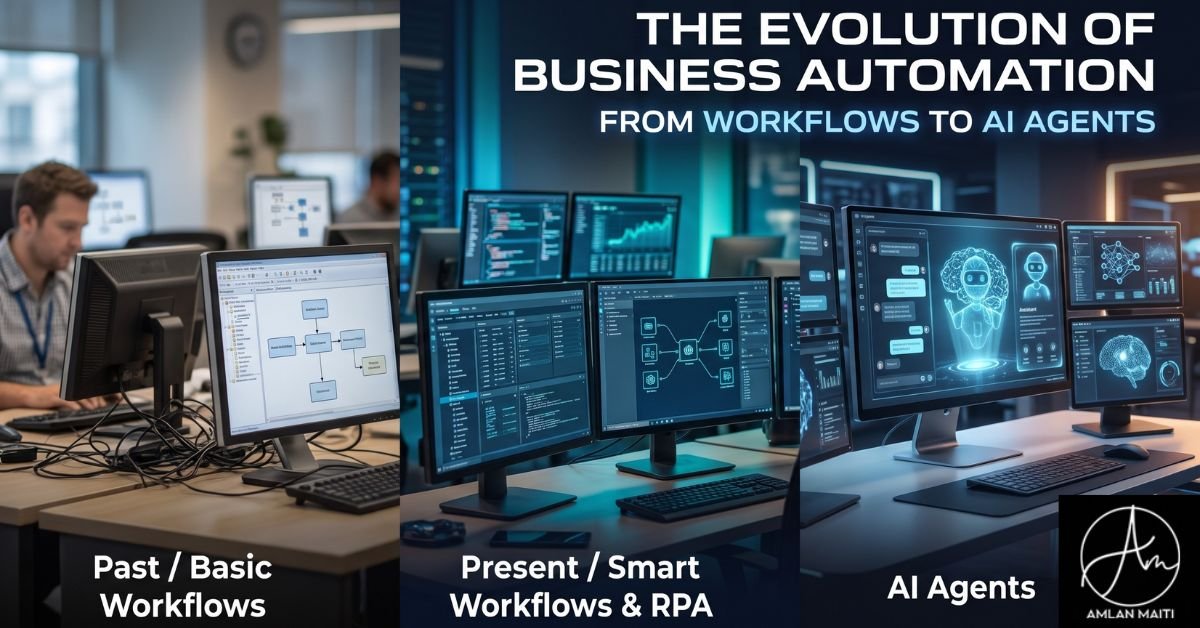
Business automation has come a long way from automatically sending emails or moving information between spreadsheets. Today, organisations are exploring systems that can interpret instructions, make decisions, and coordinate entire processes. But how did we get here, and what makes AI agents different from traditional automation? The answer reveals an important shift in how businesses operate and grow.
For years, automation focused on making repetitive work faster and more consistent. That approach still matters, but modern businesses increasingly need systems that can respond to changing situations. Whether a company is improving customer service, managing digital operations, or working with an AI SEO expert in Colombia, intelligent automation is becoming part of a broader conversation about efficiency, adaptability, and business performance.
Where Business Automation Began
The earliest forms of business automation were designed around predictable tasks. If an employee completed a form, a system could send an acknowledgement. If an invoice reached a particular stage, software could notify the accounts team. These processes reduced manual effort without changing the underlying decision-making structure.
As business software developed, automation became more sophisticated. Customer relationship management platforms, enterprise resource planning systems, and workflow applications allowed companies to connect departments and standardise operations.
Traditional workflow automation generally follows predefined instructions. A process starts when a specific event occurs, moves through established steps, and finishes when its conditions are satisfied. Think of it as a railway line: every train follows a planned route, and the system works well when nothing unexpected happens.
The Rise of Connected Workflow Automation
Businesses eventually realised that automating individual tasks was not enough. The bigger opportunity was connecting activities across departments.
For example, when a customer places an online order, several processes may need to happen together:
- The ecommerce platform confirms the purchase and records customer details.
- The inventory system checks product availability and updates stock levels.
- The payment gateway processes the transaction and generates confirmation.
- The fulfilment team receives the order information for dispatch.
Workflow automation brings these activities together, reducing delays caused by manual communication. Integration platforms and application programming interfaces (APIs) also help different software systems exchange information.
This stage changed the role of automation. Instead of simply completing isolated tasks, technology began coordinating business processes from beginning to end.
Why Traditional Automation Has Limitations
Despite its advantages, rule-based automation has a weakness: it generally depends on conditions someone has already defined.
Imagine an automated customer support system that routes every billing complaint to the accounts department. It works perfectly until a customer reports a suspicious payment that also requires fraud investigation. If the workflow cannot recognise that additional context, a human employee must intervene.
Traditional automation can struggle when information is incomplete, instructions are ambiguous, or circumstances change unexpectedly. It may execute a process efficiently without understanding whether the result makes sense.
Common limitations include:
- Rigid instructions: Changes in business rules often require manual workflow updates.
- Limited context: Systems may process individual fields without understanding the wider situation.
- Human intervention: Unusual cases frequently need employees to make decisions or correct errors.
- Disconnected operations: Poor integration can leave information trapped in separate applications.
These challenges created demand for automation that could do more than follow instructions.
The Shift Towards AI-Powered Automation
Artificial intelligence introduced a different approach. Instead of relying exclusively on fixed rules, AI-powered systems can analyse information, recognise patterns, interpret language, and generate responses.
Machine learning, natural language processing, and generative AI have expanded what automated systems can accomplish. A customer service application, for instance, can now interpret a written complaint, identify its likely subject, summarise the customer’s concern, and suggest an appropriate response.
That does not mean every AI system can operate independently. Many applications still rely on predefined workflows, human approval, and clear operating boundaries. However, the combination of conventional automation and AI makes business processes more adaptable.
From executing instructions to interpreting information
Consider a marketing team reviewing hundreds of incoming leads. A conventional workflow might assign leads according to their location or the form they submitted. An AI-enabled system could also examine their questions, engagement history, and stated requirements to estimate which enquiries deserve attention first.
The distinction is important. The system is no longer simply moving information. It is helping people interpret that information and decide what to do next.
AI Agents: The Next Stage of Business Automation
AI agents represent a further development. An AI agent is a system designed to pursue a defined goal by interpreting context, selecting actions, using available tools, and evaluating the results. Depending on its design and permissions, it may complete several connected tasks with limited human involvement.
For example, imagine a sales team asking an AI agent to prepare a follow-up for a qualified prospect. The agent might:
- Review the available customer relationship management records.
- Summarise previous conversations and identify the prospect’s requirements.
- Prepare a personalised follow-up message.
- Check relevant product information before suggesting an appropriate next step.
- Request approval from a sales representative before sending the message.
The important difference is that an agent can coordinate multiple actions towards a goal rather than merely execute one predetermined sequence. It may also adjust its approach when it encounters new information, within the boundaries of its design.
How AI agents differ from traditional workflows
Traditional workflows are generally process-oriented: they follow established steps. AI agents are more goal-oriented: they can determine which available actions may help achieve an assigned objective.
However, agents are not automatically reliable or suitable for every business activity. Their decisions depend on the quality of their data, instructions, tools, and access permissions. Human oversight remains essential, especially when financial, legal, or customer-sensitive decisions are involved.
Where Businesses Can Use Intelligent Automation
The practical opportunities extend across departments. Businesses do not need to replace their existing software to benefit; they can often introduce AI capabilities into selected processes first.
- Customer support: Agents can categorise enquiries, retrieve relevant information, draft responses, and escalate complex cases.
- Sales operations: Intelligent systems can research prospects, summarise conversations, and prepare follow-up recommendations.
- Marketing: AI can assist with campaign analysis, audience insights, content planning, and performance reporting.
- Finance: Automation can help organise invoices, flag unusual transactions, and support reconciliation processes.
- Human resources: AI tools can assist with recruitment administration, employee queries, and internal knowledge retrieval.
For a growing organisation, these improvements can reduce administrative pressure and allow employees to spend more time on customer relationships, planning, and creative problem-solving.
Building an Effective AI Automation Strategy
Adopting AI agents should not begin with the technology itself. A better starting point is identifying where employees lose time, where information gets delayed, and which repetitive decisions create operational bottlenecks.
Practical steps for implementation
- Identify the right process: Start with a frequent, well-understood task that has measurable business value.
- Review existing systems: Check whether your CRM, ERP, databases, and communication tools can exchange information reliably.
- Choose suitable automation: Use rule-based workflows for predictable tasks and AI-supported systems where interpretation or contextual analysis adds value.
- Establish permissions: Define which actions an AI agent can perform independently and which require human approval.
- Measure performance: Track processing time, error rates, employee workload, customer satisfaction, and overall return on investment.
Security deserves equal attention. Businesses should apply access controls, protect sensitive information, maintain activity logs, and establish clear procedures for reviewing automated decisions. Frameworks such as the NIST AI Risk Management Framework provide useful guidance for identifying and managing AI-related risks.
The Future: Human Expertise and Autonomous Systems Working Together
The evolution of automation does not suggest that human employees will become unnecessary. Rather, it changes where their expertise is most valuable.
Machines are particularly useful for processing large volumes of information, coordinating repetitive activities, and identifying patterns. People remain essential for understanding business priorities, handling sensitive situations, building trust, and making decisions that require judgement.
Over time, businesses may connect multiple specialised agents to manage larger operational processes. A marketing agent could share campaign insights with a sales agent, while a customer service agent could identify recurring product complaints and send those insights to the appropriate team.
Such systems could make organisations more responsive, but successful implementation will depend on reliable integration, transparent decision-making, and meaningful human supervision.
Frequently Asked Questions
1. What is the difference between workflow automation and AI automation?
Workflow automation follows predefined rules and sequences to complete tasks. AI automation can interpret information, recognise patterns, and support decisions, making it more adaptable when situations are less predictable.
2. How are AI agents different from chatbots?
A traditional chatbot primarily responds to user messages. An AI agent can go further by pursuing an assigned goal, using connected tools, coordinating multiple actions, and evaluating outcomes within its permissions.
3. Can small businesses benefit from AI agents?
Yes. Small businesses can use AI agents for customer enquiry management, lead organisation, reporting, appointment coordination, and other repetitive activities. Starting with a limited, measurable use case can help control costs and implementation risks.
4. Will AI agents replace traditional workflow automation?
Not entirely. Rule-based workflows remain effective for predictable, structured tasks. AI agents are more useful when processes require interpretation or flexible decision-making. Many organisations will benefit from combining both approaches.
Final Thoughts
Business automation has moved from simple task execution towards systems capable of interpreting information and coordinating intelligent actions. AI agents are an important part of this evolution, but their value comes from solving genuine operational problems, not simply introducing new technology. Businesses that combine automation with human judgement will be better positioned to build efficient, adaptable operations.
Blog Development Credits
This article was conceptualised by Amlan Maiti, developed through research and AI-assisted writing, then refined with strategic SEO improvements by Digital Piloto Private Limited.
Related Articles
31 October 2026
How to Monitor Brand Mentions in AI-Generated Answers
When someone asks an AI assistant to recommend a reliable company, compare products, or explain an industry, does your brand…
30 October 2026
Enhancing Marketing ROI Through Intelligent Customer Segmentation
Why do some marketing campaigns generate impressive returns while others consume budgets without producing meaningful results? Often, the difference is…
29 October 2026
The Impact of AI Agents on B2B Prospecting and Lead Generation
Finding the right business prospect has never been just a numbers game. Sales teams can contact hundreds of companies and…

Get In Touch
Initiate your digital marketing journey by filling out this form.