



Recent Post
- Knowledge Graph SEO: Why Entities Matter in the Age of AI Search
- AI Discovery Index: A New Way to Think About Brand Visibility
- How to Optimize Content for AI Answers Without Losing Human Engagement
- The Future of SEO: From Keywords and Rankings to Entities and AI Retrieval
- AI Citations vs Google Rankings: Understanding the New Search Visibility Model
- How Generative Engines Decide Which Brands to Mention
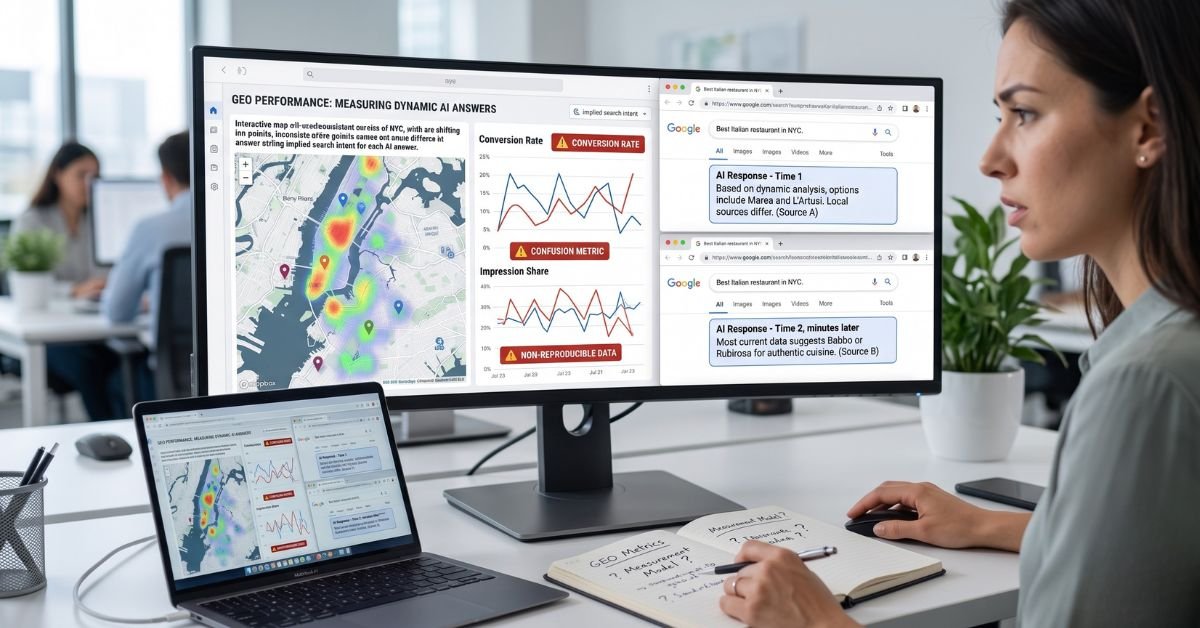
AI search does not behave like a traditional results page. Ask the same question today and tomorrow, and the answer may change, along with the brands, sources, and recommendations shown. That can make Generative Engine Optimization feel difficult to quantify. The solution is not chasing every fluctuation, but building a measurement system that reveals meaningful patterns.
For an AI SEO Specialist in Mexico, one of the biggest challenges is explaining this difference to businesses accustomed to tracking rankings. GEO performance needs a wider lens, combining AI mentions, citations, visibility, competitors, website engagement, and ultimately business outcomes.
Why GEO Metrics Keep Moving
Traditional SEO gives businesses familiar reference points: rankings, impressions, clicks, and conversions. AI search introduces more variables. The model may interpret a prompt differently, retrieve different sources, consider location, or generate a different combination of brands.
BrightLocal’s 2026 research illustrates this volatility. Its study of more than 200,000 local AI searches found that repeated searches did not consistently produce identical results across major AI platforms. Yet individual businesses could still appear repeatedly across different searches.
That distinction matters. A changing answer does not necessarily mean your GEO strategy is failing. It may simply mean the environment itself is dynamic.
Start With AI Mention Tracking
The first useful metric is straightforward: how frequently does AI mention your brand for relevant prompts?
Create a fixed collection of questions your customers might ask. Include commercial searches such as “best accounting software for small businesses” alongside informational queries such as “how can a growing company improve cash flow?”
- Record whether your brand appears.
- Note which competitors appear with it.
- Capture the wording used to describe your business.
- Track the result across several AI platforms.
Over time, the pattern becomes more valuable than any individual response. If your brand moves from occasional mentions to regular appearances across relevant prompts, that is a useful GEO signal.
Measure Share of Voice
Being mentioned is one thing. Being mentioned alongside every major competitor is another.
GEO share of voice measures how much of the visible brand discussion belongs to your company compared with competing businesses. For example, imagine 100 relevant AI answers produce 240 total brand mentions, and your company receives 36 of them. Your share is approximately 15%.
That number does not need to be perfect to be useful. What matters is consistency in how you calculate it.
Track These Competitor Signals
- Which competitors appear most often?
- Which brands are repeatedly recommended for commercial prompts?
- What characteristics does AI associate with those brands?
- Are competitors being cited from sources your business does not yet have?
This turns GEO measurement into something actionable. Instead of simply saying, “We are not appearing,” you can ask, “What information or authority signals are helping competing brands appear?”
Citations Can Reveal Your Hidden SEO Gaps
AI answers are often built from sources. Those sources can include company websites, publishers, directories, review platforms, professional organisations, and other online references.
That makes citation tracking particularly valuable. BrightLocal’s 2026 local AI visibility research reported that business websites represented a large share of unique domains appearing as AI sources, while websites accounted for 42% of citations in its dataset.
For a business owner, the practical questions are simple:
- Is AI citing your website?
- Which pages are being referenced?
- Are third-party sources describing your company accurately?
- Are competitors receiving citations from stronger or more relevant sources?
Sometimes a citation gap exposes a content gap. Other times it reveals a reputation or authority problem. Either way, the data gives you somewhere concrete to investigate.
Connect GEO Visibility With Revenue
Here is where measurement gets serious. A rise in AI mentions sounds encouraging, but what happened afterward?
B2B companies might track qualified leads, demo requests, sales opportunities, and pipeline value. B2C brands may care more about purchases, bookings, calls, store visits, or repeat customers.
A practical GEO dashboard can therefore include:
- Visibility: AI mentions, share of voice, answer position.
- Authority: citations, referring domains, reviews, and brand references.
- Engagement: AI-referred traffic and branded search activity.
- Business results: enquiries, conversions, revenue, or qualified pipeline.
This prevents a common mistake: celebrating visibility metrics that never translate into customer activity.
Build a Repeatable GEO Testing Process
Consistency is your best friend when the search environment is inconsistent.
Keep a core prompt library. Test it on a defined schedule. Record the complete answers rather than screenshots of only the first few lines. Separate branded queries from generic ones, and keep local variations separate when geography matters.
Most importantly, avoid changing your methodology every time an answer surprises you. Otherwise, you will end up measuring your measurement system rather than your GEO performance.
FAQs
What is the most important GEO metric?
There is no universal single metric. Mention rate, share of voice, citations, answer position, engagement, and conversions work better together than individually.
Why do AI answers change for the same question?
AI systems can use different sources, retrieval processes, context, locations, models, and interpretation methods. Consequently, identical or similar prompts may produce different answers.
How often should businesses measure GEO?
Monthly tracking is a sensible starting point for many businesses. High-priority campaigns can be monitored more frequently, provided the prompt set and measurement method remain consistent.
Can GEO metrics replace traditional SEO metrics?
No. GEO should complement traditional SEO. Rankings, impressions, organic traffic, conversions, technical health, and AI visibility together provide a broader picture of search performance.
Final Thoughts
GEO measurement is not about forcing an unpredictable AI system into a rigid ranking report. It is about finding stable signals inside an unstable environment. Track recurring prompts, monitor mentions and citations, compare competitors, and connect visibility with real business outcomes. That approach gives you something far more useful than a single AI answer: a trend you can actually act on.
Blog Development Credits
The concept originated with Amlan Maiti, with AI-assisted research and drafting, followed by strategic SEO refinement from Digital Piloto Private Limited.
Related Articles

30 September 2026
Knowledge Graph SEO: Why Entities Matter in the Age of AI Search
Search engines are no longer simply matching words on pages. They are trying to understand people, businesses, products, places, and…
28 September 2026
AI Discovery Index: A New Way to Think About Brand Visibility
For years, brand visibility had a familiar scoreboard: rankings, impressions, clicks, and traffic. AI search is quietly changing that game.…
27 September 2026
How to Optimize Content for AI Answers Without Losing Human Engagement
Search is becoming a strange hybrid: people still want useful, persuasive content, while AI systems increasingly decide which information deserves…

Get In Touch
Initiate your digital marketing journey by filling out this form.