



Recent Post
- Entity SEO: Why Context May Matter More Than Keywords in AI Search
- How AI Can Connect SEO, Paid Ads, CRO and Lead Generation
- How Multi-Agent AI Systems Could Reshape Performance Marketing
- Agentic AI Marketing: How Autonomous AI Agents Are Changing Digital Marketing
- Knowledge Graph SEO: Why Entities Matter in the Age of AI Search
- AI Discovery Index: A New Way to Think About Brand Visibility
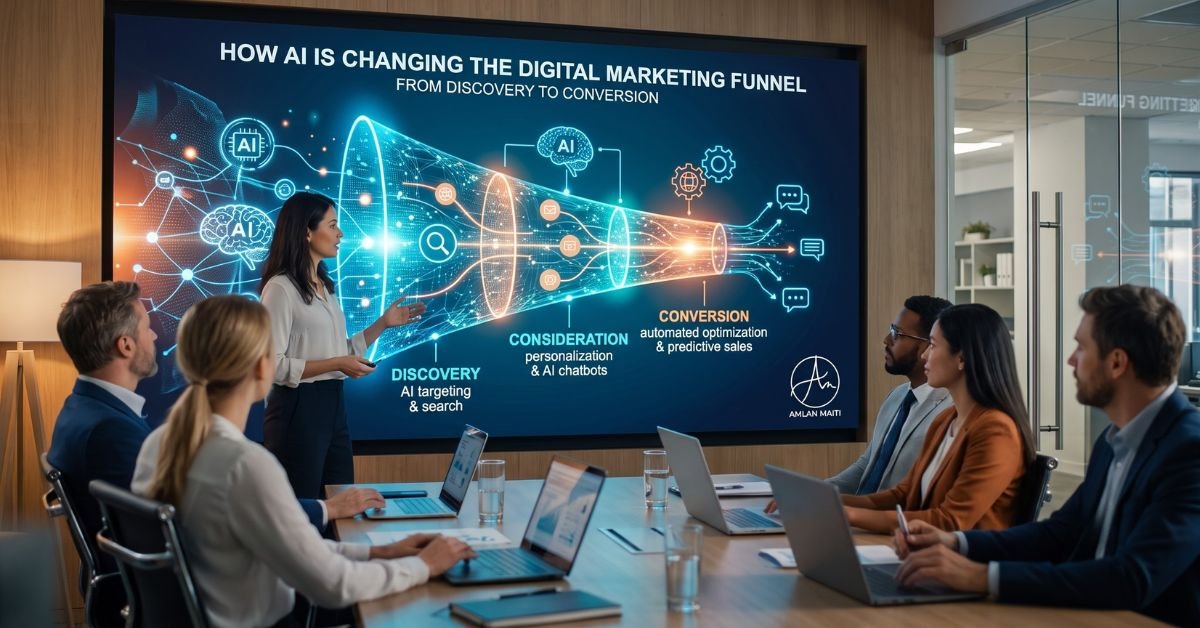
The old marketing funnel was fairly predictable: attract attention, build interest, encourage consideration, and eventually convert. AI is making that journey less linear. People can discover a brand, compare alternatives, ask an AI tool for recommendations, and return to a website already knowing what they want. The funnel still exists, but it behaves very differently now.
For an AI SEO expert in Kolkata, this shift is particularly interesting because search is no longer just about ranking pages. It is increasingly about being discoverable, understandable, trustworthy, and useful across several moments of the customer’s decision-making process.
Why the Traditional Funnel Is Losing Its Straight Line
Think of the traditional funnel as a staircase. A prospect takes one step at a time: discovers a company, visits its website, reads some information, compares options, and then submits an enquiry.
Real customers rarely behave so neatly anymore.
Someone might see a brand in an AI-generated search answer, watch a short video, read reviews, visit the website, leave, ask an AI assistant for alternatives, and return two days later through a branded search.
That means marketers need to think less about forcing people through predefined stages and more about understanding the signals appearing throughout the journey.
Research from Google’s Think with Google has previously described this decision-making period as a “messy middle,” where consumers explore and evaluate options before choosing. AI adds another layer to that already complicated process.
AI Is Changing Discovery at the Top of the Funnel
Discovery used to be dominated by search engines, social platforms, advertisements, referrals and word of mouth. Those channels still matter, but AI has created another discovery layer.
Instead of searching ten websites, a consumer can ask a conversational system something like, “What are the best agencies for an ecommerce business in India?” The response may present a shortlist, explain differences and suggest what to consider.
That changes the marketing question from:
“How do I rank for this keyword?”
to:
“How does my brand become a credible answer to this customer’s problem?”
This is where AI search visibility, entity optimization and generative search optimization become increasingly relevant.
Google’s current guidance on generative AI search states that its AI features continue to rely on core Search systems and recommends the same fundamentals marketers have long needed: helpful content, accessible pages, clear information and strong technical foundations.
AI Makes Consideration More Personal
Once someone knows a brand exists, the next question is usually, “Is this right for me?”
This is the consideration stage, and AI can make it considerably more contextual.
AI-powered experiences can help users compare products, summarize information, explain complicated services and surface answers based on specific circumstances. For marketers, that means generic product descriptions and broad claims may have less influence than clear, evidence-backed information.
A strong consideration-stage strategy should therefore answer practical questions before the prospect has to ask them:
- Who is this product or service actually suitable for?
- How does it compare with common alternatives?
- What does implementation or purchase involve?
- What problems does it solve, and what problems does it not solve?
- What evidence supports the company’s claims?
This is also where useful case studies, original research, expert explanations, FAQs and transparent comparisons can strengthen trust.
AI Is Reshaping the Conversion Stage
Conversion is often treated as the final click: a form submission, phone call, purchase or booking.
But AI can influence what happens immediately before that action.
Imagine a visitor arriving on a service page after researching the company through an AI search experience. They may already understand the basics. Showing them another 1,500 words of generic introductory content could actually slow the decision down.
The better experience might be a clear explanation of the service, proof of expertise, pricing guidance, relevant results, FAQs and a straightforward next step.
AI can help marketers identify these patterns by analysing behavioural data, conversion paths and customer interactions.
It can also assist with:
- Identifying pages with strong traffic but weak conversion rates.
- Finding common questions appearing in sales and support conversations.
- Segmenting visitors according to intent or behaviour.
- Personalizing follow-up messages and lead-nurturing sequences.
The important distinction is that AI should improve the decision environment rather than simply add more automation.
Lead Generation Becomes More Intelligent
There is a temptation to measure AI success by counting how many leads it helps generate.
That can be misleading.
A business receiving 1,000 low-quality enquiries has not necessarily achieved more than a business receiving 150 highly relevant opportunities.
AI can connect marketing interactions with CRM and sales information to reveal which audiences, campaigns and content themes are associated with better outcomes.
That creates a more useful funnel measurement model:
- Discovery: Was the brand found?
- Engagement: Did the prospect find the information relevant?
- Intent: Did behaviour indicate genuine commercial interest?
- Conversion: Did the visitor take a meaningful action?
- Qualification: Did the lead fit the business?
- Revenue: Did the opportunity ultimately create business value?
This is where AI-driven lead generation becomes more than automated form filling. The objective is to connect marketing activity with downstream commercial outcomes.
AI Also Changes What Happens After Conversion
One of the most overlooked changes is what happens after the initial conversion.
A customer who purchases today may have questions tomorrow. Another customer may be ready for an upgrade six months later. Someone who downloads a guide may not be sales-ready yet but could become valuable with the right education.
AI can help segment these audiences and determine what type of communication makes sense next.
For example, an ecommerce business might use purchase history and behavioural signals to recommend relevant products. A B2B company could use engagement patterns to prioritize leads for sales follow-up. A service business could identify prospects who repeatedly visit high-intent pages.
In each case, the funnel becomes less like a disposable pipeline and more like a continuing relationship.
The New Funnel Is Really a Feedback Loop
The most effective AI marketing strategies do not treat discovery, consideration and conversion as isolated stages.
They connect them.
Suppose a sales team repeatedly hears the same objection. AI can identify that pattern from call transcripts or CRM notes. Marketing can turn the objection into an educational article. SEO can target the related search demand. Paid media can test the new message. CRO can place the explanation on relevant landing pages.
Suddenly, one customer insight has improved several parts of the funnel.
That is the real advantage.
AI does not merely make each department faster. It can help information travel between departments.
What Marketers Should Prioritize Now
Businesses do not need to automate everything at once. A sensible approach is to strengthen the areas where better intelligence can produce measurable commercial value.
- Map customer questions: Identify what people ask before, during and after purchase.
- Connect marketing data: Bring search, advertising, website and CRM insights closer together.
- Improve content depth: Create useful material that answers real decision-making questions.
- Measure quality: Track qualified opportunities and revenue, not just clicks and leads.
- Keep human oversight: Let AI identify patterns and possibilities while people make strategic decisions.
For many businesses, this approach is more sustainable than chasing every new AI marketing feature that appears.
Frequently Asked Questions
How is AI changing the digital marketing funnel?
AI is making the funnel more dynamic by influencing discovery, personalization, content recommendations, lead qualification, conversion optimization and post-conversion engagement. Customers can now move between stages in less predictable ways.
Does SEO still matter when people use AI search?
Yes. AI search experiences still rely heavily on web content, search systems, relevance and information quality. SEO fundamentals remain important, while marketers also need to consider brand visibility and citations in AI-generated answers.
Can AI improve lead quality?
It can. By combining behavioural, campaign and CRM signals, AI can help identify patterns associated with qualified leads and distinguish meaningful commercial intent from low-value conversions.
Will AI make traditional marketing funnels obsolete?
Not completely. The funnel remains a useful planning model, but customer journeys are becoming less linear. Businesses should treat the funnel as a connected feedback loop rather than a rigid sequence of steps.
Final Thoughts
AI is not simply adding another tool to the digital marketing stack. It is changing how the pieces communicate.
Discovery influences content. Content influences consideration. Consideration shapes conversion. Conversion creates customer data, and that data can improve the next discovery cycle.
The businesses that benefit most will probably not be those using the greatest number of AI tools. They will be the ones connecting customer signals intelligently and turning those signals into better experiences from the first question to the final decision.
Blog Development Credit
Conceptualized by Amlan Maiti, researched and developed with ChatGPT, Google Gemini and Copilot, then refined and SEO-optimized by Digital Piloto Private Limited.
Related Articles
05 October 2026
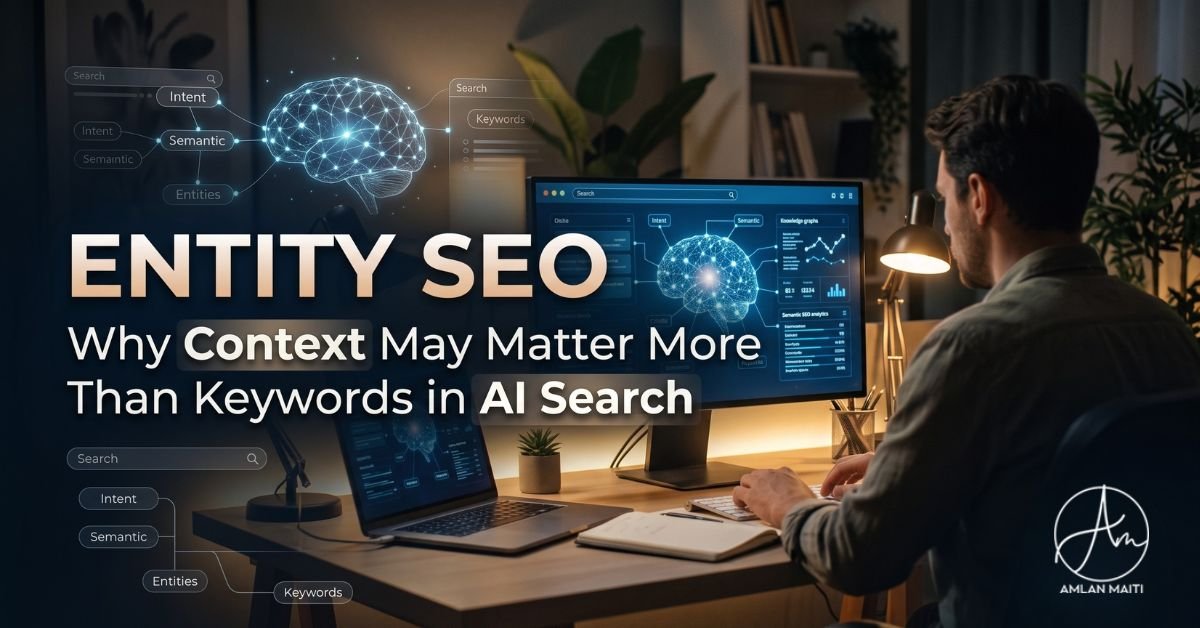
Entity SEO: Why Context May Matter More Than Keywords in AI Search
For years, SEO taught marketers to think in keywords. But AI search is changing the question. Instead of simply matching…

03 October 2026
How AI Can Connect SEO, Paid Ads, CRO and Lead Generation
SEO brings people in. Paid ads create immediate opportunities. CRO tries to turn those visits into action, while lead generation…

02 October 2026
How Multi-Agent AI Systems Could Reshape Performance Marketing
Performance marketing has always been about coordination: media buyers, analysts, creative teams and marketers watching the same funnel from different…

Get In Touch
Initiate your digital marketing journey by filling out this form.