




Recent Post
- Entity SEO: Why Context May Matter More Than Keywords in AI Search
- How AI Is Changing the Digital Marketing Funnel From Discovery to Conversion
- How Multi-Agent AI Systems Could Reshape Performance Marketing
- Agentic AI Marketing: How Autonomous AI Agents Are Changing Digital Marketing
- Knowledge Graph SEO: Why Entities Matter in the Age of AI Search
- AI Discovery Index: A New Way to Think About Brand Visibility
SEO brings people in. Paid ads create immediate opportunities. CRO tries to turn those visits into action, while lead generation keeps the sales pipeline moving. Yet these functions often operate in separate boxes. AI can change that. Instead of optimizing each channel in isolation, businesses can use connected data and intelligent automation to make the entire customer journey work harder.
That shift is where an AI SEO expert can add strategic value: not simply using AI to produce more content, but helping teams understand how search behaviour, advertising, website experience and lead quality influence one another.
The Problem With Marketing Channels Working Alone
Picture a business running four different teams inside the same shop.
The SEO team brings visitors through the front door. The paid media team puts up signs outside. The CRO team rearranges the shelves. The sales team talks to the people who actually walk in.
If none of those teams share information, something important gets lost.
SEO may report growing organic traffic while sales complains that leads are weak. Paid ads may generate hundreds of conversions, but nobody checks whether those conversions become customers. CRO may improve a landing-page conversion rate while reducing the quality of enquiries.
AI can act as the connective layer between these activities. It can analyse signals from multiple sources, identify patterns faster than manual reporting, and help marketers move from isolated channel metrics toward a common business objective.
AI Turns SEO Data Into Business Intelligence
SEO has traditionally focused on rankings, impressions, clicks and organic traffic. Those metrics still matter, but AI makes it possible to ask better questions.
For example:
- Which organic topics attract visitors who eventually become qualified leads?
- Which search queries bring traffic but consistently produce poor engagement?
- Which pages influence conversions even when they are not the final landing page?
- Which content gaps appear repeatedly across customer conversations and paid-search data?
This changes the role of SEO. Instead of simply chasing keywords, marketers can use search data as a source of customer intelligence.
Google itself continues to position foundational SEO as relevant to its generative AI search experiences. Its current guidance explains that generative features use core Search systems and retrieved web content, reinforcing the importance of technically accessible, useful and original pages.
That matters because the same content intelligence can serve several channels. A high-performing organic topic might become a paid-search theme, a landing-page test, a sales enablement asset or even a new lead magnet.
Connecting SEO With Paid Advertising
SEO and paid search are often compared as competing channels. In reality, they can behave more like two research teams.
Paid campaigns can reveal commercial intent quickly. Search terms, ad engagement and conversion data may show what people are willing to act on today. SEO can then use those insights to strengthen organic content around proven demand.
The reverse is equally useful. Strong organic pages can reveal subjects, questions and messaging that deserve paid promotion.
AI makes this feedback loop easier to manage. It can cluster search terms, identify intent patterns, compare landing-page performance and highlight areas where paid and organic strategies overlap.
Google Ads already uses machine learning at auction time to optimize bids according to conversion likelihood and business objectives. Its Smart Bidding documentation explains that automated strategies can optimize for either conversion volume or conversion value using contextual signals.
The bigger opportunity, however, is not simply letting an algorithm bid faster. It is giving the algorithm better business signals.
If every form submission is treated as an equal conversion, the system may optimize toward quantity. If qualified opportunities, revenue or customer value are incorporated into measurement, optimization can move closer to what the business actually wants.
AI Can Find the Leak Between Click and Lead
Here is where CRO becomes especially important.
A company might celebrate a 30% increase in paid traffic. But if the landing page loads slowly, the message does not match the ad, or the form asks for unnecessary information, more traffic simply means more people encountering the same problem.
AI can help diagnose those gaps by combining behavioural and campaign information.
For example, an AI-assisted analysis might reveal that:
- Mobile visitors from paid search abandon the form more frequently than desktop visitors.
- A particular ad promises a specific service, but the landing page opens with a generic company message.
- Visitors from informational SEO content need more education before they are ready for a sales enquiry.
- One form generates many submissions but very few sales-qualified opportunities.
These insights are more useful than simply knowing that a landing page has a 4% conversion rate.
AI can also support experimentation by identifying possible test opportunities: different headlines, shorter forms, clearer calls to action, stronger proof points, alternate page structures or more relevant follow-up messages.
But there is an important caveat. AI should recommend and analyse tests; it should not blindly rewrite the entire website every week. Good CRO still depends on controlled experiments, business context and human judgement.
From Conversion Rate to Lead Quality
This is arguably the most important connection in the whole system.
A marketing team can improve almost any surface-level metric if it optimizes for the wrong outcome.
Imagine two campaigns. Campaign A produces 500 leads at a low cost, but only five become genuine opportunities. Campaign B produces 120 leads at a higher cost, but 30 become qualified sales conversations.
If the dashboard only reports cost per lead, Campaign A looks brilliant.
If the business measures cost per qualified opportunity or revenue generated, the picture changes dramatically.
AI can help marketers connect these stages by analysing CRM information alongside campaign, website and behavioural data. Instead of asking, “Which channel generated the most leads?” the more useful question becomes, “Which combination of audience, message, channel and experience generated the most valuable customers?”
Recent HubSpot research illustrates why this broader view matters. Its 2026 State of Marketing research found that 33% of marketers identified measuring marketing ROI as a leading challenge, while lead generation was cited by 29.6%. The report also found that 86.4% of marketing teams use AI in at least some areas.
In other words, adoption is moving quickly, but measurement remains difficult. More AI does not automatically solve that problem. Connected data does.
Building an AI-Connected Marketing Loop
The strongest approach is not to bolt an AI tool onto every department. It is to create a shared learning loop.
1. Start with a common business goal
Choose an outcome that matters across departments: qualified leads, sales opportunities, revenue, customer acquisition cost or lifetime value.
2. Connect the signals
Bring together search data, advertising performance, website behaviour, CRM outcomes and conversion information wherever technically and legally appropriate.
3. Let AI identify patterns
Use AI to find relationships humans may overlook. Look for recurring search intent, audience segments, content themes, landing-page friction and differences in lead quality.
4. Turn insights into experiments
Do not stop at dashboards. Convert useful findings into actions: new content, revised ad messaging, landing-page tests, audience adjustments or better lead nurturing.
5. Feed outcomes back into the system
The loop only becomes intelligent when downstream results influence future decisions. If one campaign generates cheap leads that never close, that information should eventually affect campaign evaluation.
Where GEO and AI Search Fit Into the Picture
The customer journey is also changing before the click even happens.
People increasingly use AI-powered search experiences to compare providers, understand problems and narrow their options. That means a brand may influence a buying decision without receiving a traditional organic click first.
This is where an AI search visibility strategy becomes an extension of SEO rather than a completely separate discipline.
A strong generative engine optimization agency approach can help businesses think about how their expertise, products and services are represented across emerging AI-driven discovery experiences.
Google’s own guidance now discusses generative AI search alongside traditional SEO and recommends continuing to focus on unique, useful, people-first content rather than chasing artificial optimization tricks.
The practical implication is simple: your website still needs to be useful to people, but your measurement framework should increasingly account for how people discover and evaluate your brand before they reach the site.
What an AI-Driven Dashboard Should Actually Show
A modern marketing dashboard does not need hundreds of numbers. It needs the right connections.
- Discovery: organic visibility, paid reach, AI search visibility and branded demand.
- Engagement: qualified traffic, landing-page behaviour and content interaction.
- Conversion: form submissions, calls, bookings, purchases and conversion rates.
- Quality: marketing-qualified leads, sales-qualified leads and opportunity rates.
- Business impact: customer acquisition cost, pipeline value, revenue and lifetime value.
AI can then help identify where performance is changing and, more importantly, where the change deserves investigation.
That last part matters. A sudden conversion-rate improvement could be a genuine win, a tracking issue, a seasonal effect or a change in traffic mix. Algorithms can surface the anomaly; humans still need to explain it.
Why Human Strategy Still Matters
It is tempting to imagine a future where AI watches the dashboard, changes the ads, rewrites the landing pages and publishes the SEO content without anyone looking over its shoulder.
That may sound efficient. It can also become expensive chaos.
Marketing is full of context that numbers do not fully capture: positioning, reputation, customer objections, competitive changes, pricing, brand voice and commercial priorities.
AI is excellent at processing patterns at scale. People are still better at deciding whether a pattern actually makes strategic sense.
The best model is therefore not “AI replaces marketers.” It is closer to “AI shortens the distance between evidence and action.”
Frequently Asked Questions
Can AI connect SEO and paid advertising?
Yes. AI can analyse organic search behaviour, paid search terms, ad performance and conversion data together. This can reveal shared customer intent and help teams coordinate content, targeting and messaging.
How does AI improve CRO?
AI can analyse behavioural and campaign data to identify potential friction points, such as weak message matching, form abandonment or differences in conversion behaviour across audiences. Those insights can inform controlled CRO experiments.
Should businesses optimize for leads or revenue?
Ideally, revenue or another meaningful downstream business outcome should influence optimization. Lead volume is useful, but it can hide major differences in lead quality and sales potential.
Will AI replace SEO, PPC or CRO teams?
AI is more likely to change how these teams work than eliminate the disciplines themselves. Strategy, creative judgement, experimentation and business context remain important even when analysis and repetitive execution become increasingly automated.
Final Thoughts
AI’s biggest marketing opportunity may not be another content generator, bidding assistant or analytics dashboard. It is the ability to connect the dots between them.
When SEO learns from paid search, paid media learns from CRM outcomes, CRO learns from audience intent, and lead generation feeds real business results back into the system, marketing becomes less like a collection of channels and more like one adaptive growth engine.
That is the real promise of AI-powered marketing: not simply doing more work, but making every part of the customer journey learn from the others.
Blog Development Credit
This article was conceptualized by Amlan Maiti, researched and developed with ChatGPT, Google Gemini and Copilot, then refined and optimized by Digital Piloto Private Limited.
Related Articles
05 October 2026
Entity SEO: Why Context May Matter More Than Keywords in AI Search
For years, SEO taught marketers to think in keywords. But AI search is changing the question. Instead of simply matching…
04 October 2026
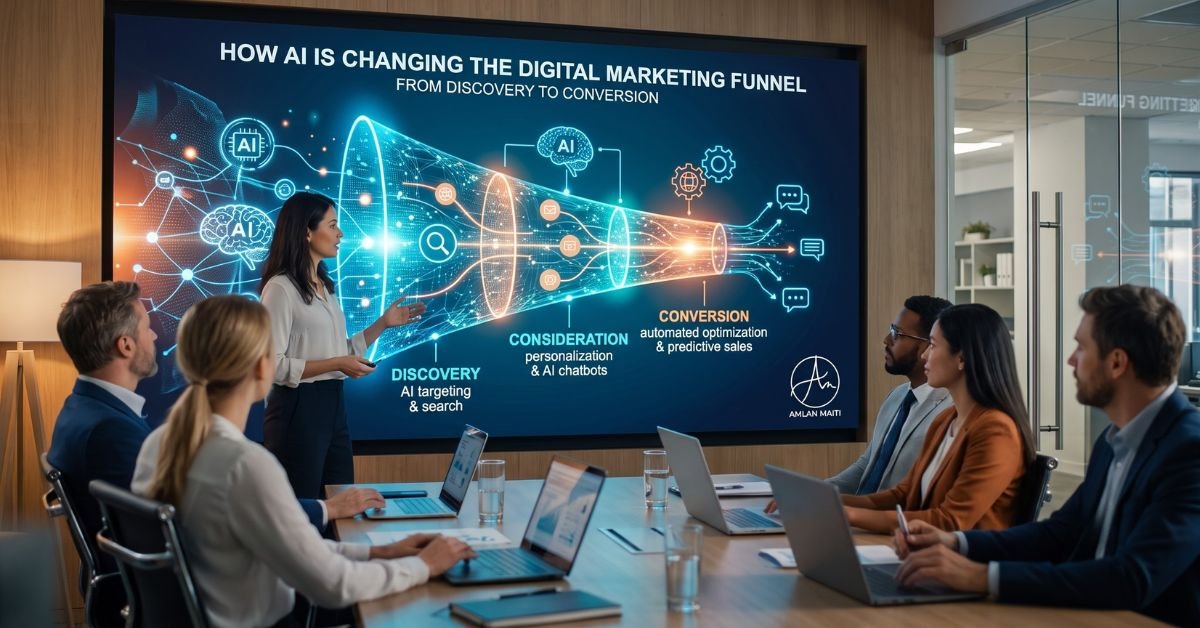
How AI Is Changing the Digital Marketing Funnel From Discovery to Conversion
The old marketing funnel was fairly predictable: attract attention, build interest, encourage consideration, and eventually convert. AI is making that…

02 October 2026
How Multi-Agent AI Systems Could Reshape Performance Marketing
Performance marketing has always been about coordination: media buyers, analysts, creative teams and marketers watching the same funnel from different…

Get In Touch
Initiate your digital marketing journey by filling out this form.