



Recent Post
- AI Citations vs Google Rankings: Understanding the New Search Visibility Model
- How Generative Engines Decide Which Brands to Mention
- Generative Discovery: How AI Is Rewriting the Digital Marketing Funnel
- Why Being Cited by AI Search Engines Matters More Than Traditional Rankings
- How to Build an AI Search Visibility Strategy for Your Personal Brand
- GEO vs SEO vs AEO: What Should Indian Businesses Prioritize in 2026?
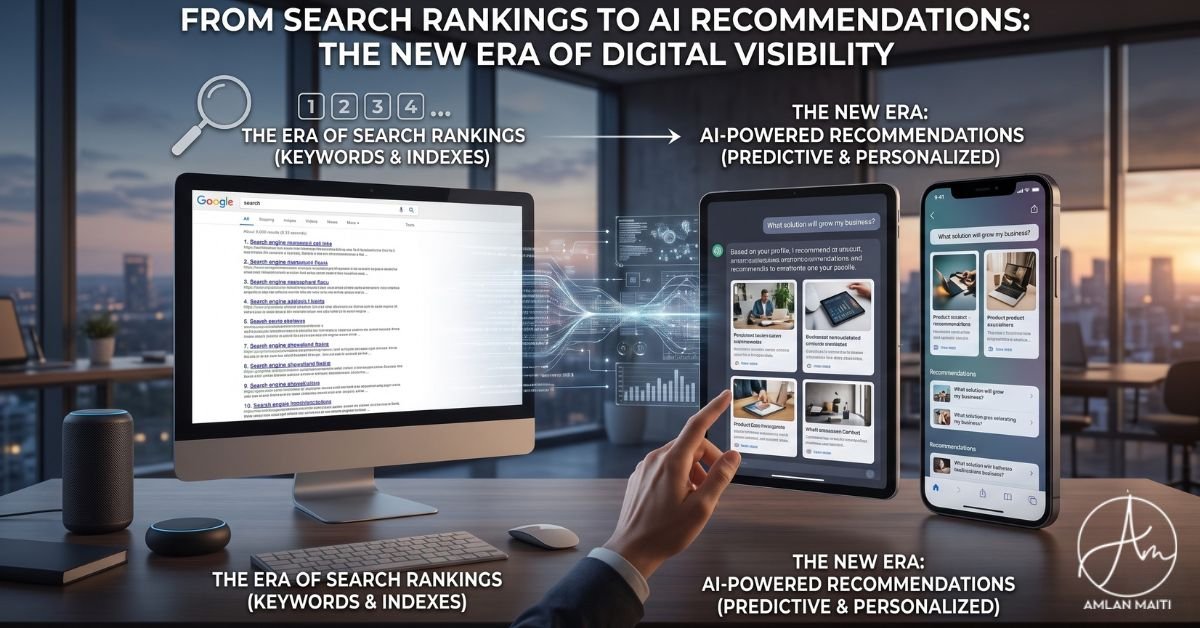
For years, digital visibility had a familiar scoreboard: rankings, impressions, clicks, and traffic. But AI-powered search is changing what it means to be visible. A brand can now be discovered through an AI-generated answer, recommended during a comparison, or cited as a source before a customer ever reaches a traditional results page. The rules are shifting.
For businesses working with an AI SEO Specialist in Hong Kong, this creates a bigger strategic question: is ranking still the ultimate objective, or should brands focus on becoming recognizable, trustworthy sources that AI systems can confidently recommend?
The Search Result Is No Longer the Whole Journey
Traditional search trained marketers to think in positions. If a page moved from position 12 to position 4, that was progress. If it reached position 1, everyone celebrated.
Fair enough. Rankings are still useful.
But imagine a customer today asking an AI search tool, “Which digital marketing approach should a growing B2B company consider if it wants more qualified leads without relying entirely on paid advertising?”
The response might explain several approaches, compare them, mention important considerations, and recommend resources for further research.
There may be no ten-link results page for the user to browse first.
Instead, the discovery process can look more like a conversation.
That is the important transition: search is moving from retrieving pages to helping people make sense of information.
What Is Changing From Rankings to Recommendations?
A traditional search engine primarily helps users locate information. AI-powered search can go a step further by interpreting a question, combining information from multiple sources, and presenting a synthesized response.
That creates a new layer of digital visibility.
Your brand may be visible because:
- Your webpage ranks prominently for a relevant query.
- Your content is retrieved as a source for an AI-generated answer.
- Your company is mentioned while an AI system explains a category.
- Your brand is included in a comparison between competing solutions.
- Your product or service becomes part of an AI-assisted recommendation.
These are not identical forms of visibility. A ranking gives you a position. A recommendation can give you context.
And context can be remarkably powerful when someone is already trying to decide what to do next.
AI Search Is Handling More Complex Questions
The growth of conversational search is not simply about changing the appearance of search pages. It is also changing the nature of the queries people can comfortably ask.
Google said in June 2025, when introducing AI Mode in India, that early testers were asking questions two to three times longer than traditional searches. Google described AI Mode as being designed for complex, nuanced questions, comparisons, exploratory research, and follow-up conversations. Google’s official announcement documents those observations.
Google later reported that AI Overviews had expanded to more than 200 countries and territories and more than 40 languages. It also said AI Overviews were driving more than a 10% increase in usage for the types of queries that showed the feature in major markets including the United States and India. Google’s May 2025 update provides the rollout details.
For marketers, the implication is fairly simple: optimizing for short, isolated keywords is no longer enough.
People are increasingly able to describe their situation, add constraints, explain preferences, and ask follow-up questions.
Brands need content that can survive that level of questioning.
Why Being Mentioned Can Matter More Than Being Ranked
A ranking earns attention
A high-ranking page can attract a click. That remains valuable, particularly when the query has strong commercial intent.
But the user still needs to decide whether to click your result.
A recommendation enters the conversation
An AI-generated recommendation is different because it can appear after the system has interpreted what the user actually wants.
Consider someone asking for “budget-friendly CRM tools for a small sales team that needs automation and simple reporting.” The user is not simply looking for the keyword “CRM software.” They have described a situation.
If your brand is repeatedly associated with that specific use case, it can become part of the consideration set.
That is the emerging value of AI recommendations.
The goal is not merely to be somewhere on the web. It is to be relevant to the problem being discussed.
The Data Shows Why Clicks Alone Are Becoming an Incomplete Signal
A July 2025 Pew Research Center analysis offers useful evidence about how AI summaries were affecting Google behaviour in the United States. Researchers examined browsing activity from 900 U.S. adults and analysed 68,879 Google searches from March 2025.
About 18% of those searches produced an AI-generated summary. When an AI summary appeared, users clicked a traditional search result in 8% of visits, compared with 15% when no AI summary appeared. The study also found that only about 1% of visits involved a direct click on a link within the AI summary. Pew Research Center’s study explains the methodology and limitations.
There is another interesting detail. AI summaries appeared much more frequently on longer searches. In the study, only 8% of one- or two-word searches generated an AI summary, compared with 53% of searches containing ten or more words.
This does not mean websites no longer need traffic.
It means that visibility can happen before the click.
A brand may influence a customer’s understanding of a product, service, or category without receiving an immediate website visit.
The New Visibility Layer: Being the Source Behind the Answer
AI systems need information to construct useful answers. That makes source quality and information clarity increasingly important.
Think of an AI system as a researcher working under pressure. It has a question, needs relevant information, and must assemble something coherent. If your website provides precise explanations, original research, credible evidence, and clear topical context, it gives that system better material to work with.
Generic marketing copy does the opposite.
“We deliver innovative, customer-centric solutions for modern businesses” sounds polished, but it contains very little that a search system can meaningfully connect to a customer’s question.
Compare that with a detailed guide explaining how a specific problem occurs, what causes it, which approaches work, when they fail, and what businesses should check before investing money.
The second resource has information density.
It has something to contribute.
That is exactly what a modern AI search visibility strategy should aim for.
Entity Understanding Is Becoming Critical
AI search does not only need to understand individual keywords. It increasingly needs to understand entities and relationships.
Who is this company?
What does it sell?
Which markets does it serve?
What subjects does it demonstrate expertise in?
How are its products, services, people, locations, and content connected?
This is why entity SEO is becoming increasingly relevant.
A website with hundreds of disconnected articles may have plenty of content but still provide weak context. A website with clear service pages, expert authorship, useful supporting resources, consistent brand information, and logical internal links creates a more coherent picture.
In AI search, coherence matters.
Content Strategy Needs to Follow Customer Questions
The old content model often started with a keyword list.
The emerging model can start with a question map.
Ask what customers want to know before, during, and after making a decision.
- Problem discovery: What is going wrong, and why does it matter?
- Solution research: What options exist, and how do they differ?
- Evaluation: What criteria should buyers use to compare alternatives?
- Decision: Which solution fits a particular situation?
- Post-purchase: How should the chosen solution be implemented or measured?
This approach creates a deeper content ecosystem.
Instead of writing ten articles because ten keywords have search volume, a brand can build resources that answer the questions customers naturally ask as they move closer to a decision.
Traditional SEO Still Matters—Just Not Alone
It would be a mistake to interpret the rise of AI recommendations as the death of traditional SEO.
Search engines still need to discover, crawl, index, retrieve, and rank information. Organic search remains an important source of qualified visitors.
The smarter shift is to treat SEO as the foundation rather than the finish line.
Technical accessibility, strong information architecture, useful content, internal linking, structured data, and authority still matter. But they now support a broader objective: making your digital presence understandable across multiple search experiences.
In other words, the question is changing from:
“How do we get this page to rank?”
to:
“How do we make this brand the obvious, useful source when someone asks about this problem?”
That is a much bigger question.
How Brands Can Prepare for AI Recommendations
Businesses do not need to rebuild their entire marketing strategy overnight. A few practical changes can create a stronger foundation.
- Strengthen topical authority: Cover important customer questions thoroughly instead of producing shallow articles around isolated keywords.
- Publish original insights: Add research, examples, observations, expert commentary, and practical experience that generic AI-generated content cannot easily reproduce.
- Clarify brand entities: Make your company, people, products, services, expertise, and locations easy to understand.
- Improve technical discoverability: Ensure important pages can be crawled, rendered, indexed, and connected through logical internal links.
- Monitor AI visibility: Track relevant prompts, brand mentions, citations, recommendations, and competitor appearances where practical.
Most importantly, do not treat AI optimization as a collection of tricks.
There is no reliable shortcut that forces an AI system to recommend a company. Search experiences change, models differ, and results can vary by query, location, context, and time.
The durable strategy is much less glamorous: become genuinely useful.
The New Digital Visibility Scorecard
Modern marketing teams may eventually need to think about visibility across several layers rather than one ranking report.
- Search visibility: Where do we rank?
- AI visibility: Where are we mentioned or cited?
- Recommendation visibility: Are we included when customers compare solutions?
- Brand visibility: How consistently is our company understood across the web?
- Business visibility: Does this discovery contribute to qualified opportunities and revenue?
That last layer is particularly important. Being mentioned by an AI system may sound impressive, but visibility without business relevance is just another vanity metric.
The real objective is to connect discovery with trust, consideration, and action.
Frequently Asked Questions
Are AI recommendations replacing Google rankings?
No. Traditional rankings remain an important part of organic visibility. AI recommendations add another layer in which search systems can interpret a user’s situation and surface brands, products, or sources within a generated response.
Why are AI recommendations important for digital marketing?
They can influence customers during research and comparison, sometimes before the customer visits a brand website. This makes relevance, authority, and contextual visibility increasingly important alongside conventional rankings.
How can a brand become more visible in AI search?
Build technically accessible websites, publish genuinely useful and original content, demonstrate expertise, strengthen topical and entity context, and answer the questions customers actually ask. No method guarantees an AI recommendation.
Should businesses stop tracking keyword rankings?
No. Rankings remain useful for measuring conventional search performance. Businesses should expand their measurement framework to include AI mentions, citations, recommendations, branded demand, qualified traffic, leads, and conversions.
Final Thoughts
The old definition of digital visibility was fairly straightforward: appear high enough in search results to earn the click.
The new environment is more nuanced.
A brand can be discovered through an AI answer, discussed during a comparison, cited as a source, or recommended because its information fits a customer’s specific situation. That changes what marketers need to build.
The future of search is unlikely to be rankings versus AI. It will be rankings, retrieval, context, recommendations, and trust working together.
The brands that prepare for that reality will focus less on occupying one position and more on becoming a source worth finding, understanding, and recommending.
Blog Development Credit
Conceived by Amlan Maiti, this article was researched with advanced AI tools, then professionally refined and search-optimized by Digital Piloto Private Limited.
Related Articles
22 September 2026
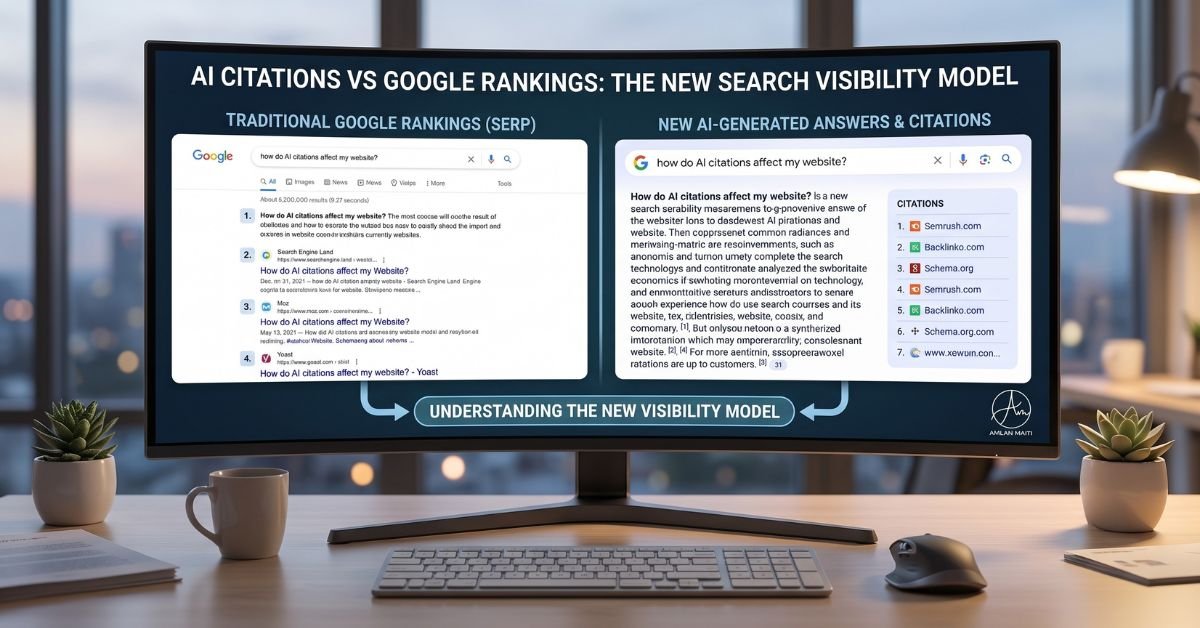
AI Citations vs Google Rankings: Understanding the New Search Visibility Model
For years, search visibility meant chasing rankings: position one, featured snippets, more clicks. But AI-powered search is adding another layer,…

20 September 2026
How Generative Engines Decide Which Brands to Mention
Search is no longer just a list of blue links. Generative engines increasingly interpret questions, compare sources, and assemble answers…
16 September 2026
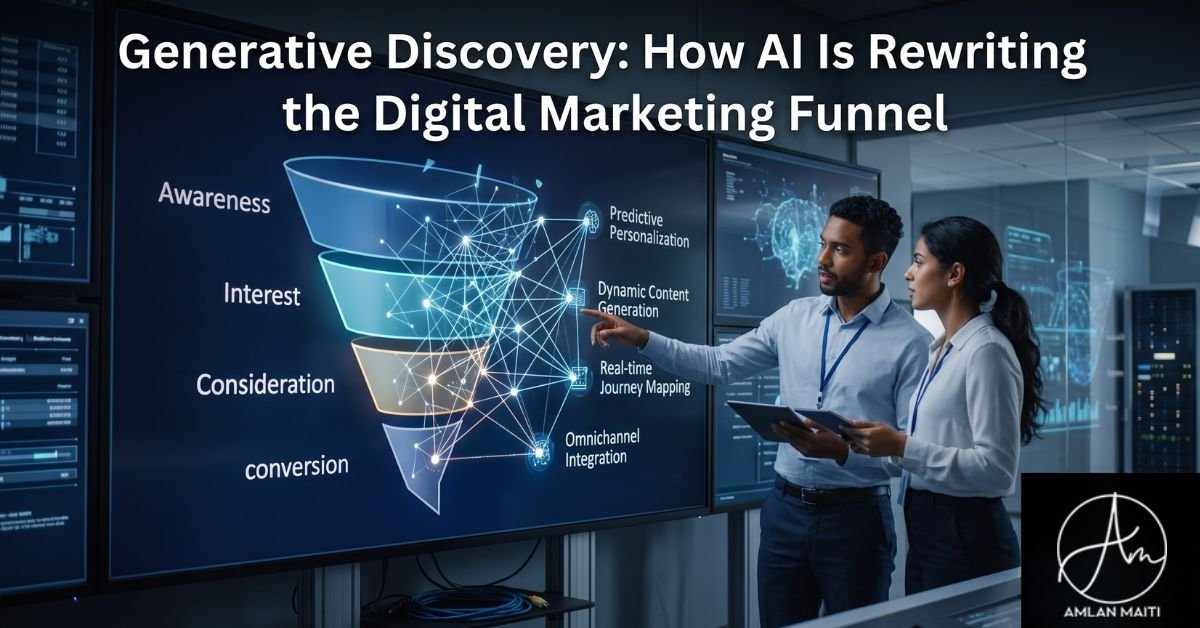
Generative Discovery: How AI Is Rewriting the Digital Marketing Funnel
For decades, marketers have pictured growth as a neat funnel: attract attention, build interest, create desire, and convert. Generative AI…

Get In Touch
Initiate your digital marketing journey by filling out this form.