



Recent Post
- Knowledge Graph SEO: Why Entities Matter in the Age of AI Search
- How to Optimize Content for AI Answers Without Losing Human Engagement
- The Future of SEO: From Keywords and Rankings to Entities and AI Retrieval
- How to Measure GEO Performance When AI Answers Keep Changing
- AI Citations vs Google Rankings: Understanding the New Search Visibility Model
- How Generative Engines Decide Which Brands to Mention
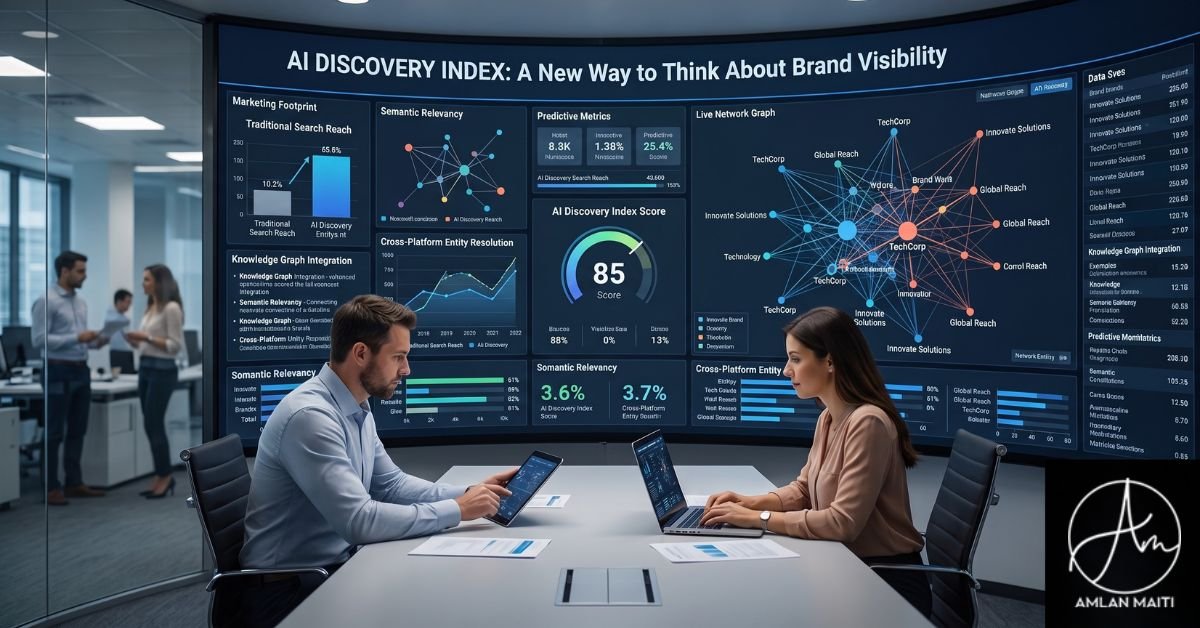
For years, brand visibility had a familiar scoreboard: rankings, impressions, clicks, and traffic. AI search is quietly changing that game. A brand can now become visible because an AI system recognizes it as relevant, trustworthy, or useful within an answer. The question is no longer simply where you rank, but whether AI can discover and understand you.
For an AI SEO Specialist in Israel, this creates an important shift in strategy. Traditional SEO still matters, but businesses also need to understand their AI brand visibility: how often they are mentioned, what sources support those mentions, and how consistently they appear when people ask AI systems questions related to their category.
What Is an AI Discovery Index?
An AI Discovery Index can be thought of as a practical framework for measuring how discoverable a brand is across AI-powered search experiences. It is not a universal ranking score issued by Google or ChatGPT. Rather, it is a way for marketers to look beyond conventional positions and assess whether their brand is entering the consideration set created by AI.
Imagine a customer asking, “Which companies should I consider for enterprise cybersecurity?” An old SEO report might tell you whether your website ranks for that phrase. An AI discovery view asks something broader: Does the system know your company belongs in this conversation?
Why Traditional Rankings Tell Only Part of the Story
AI answers can compress several searches into one conversation. A user might ask for recommendations, narrow the options, compare providers, ask about pricing, and request alternatives without ever returning to a conventional results page.
That means visibility can happen at multiple moments. A brand could be mentioned during research but disappear during comparison. Another company might appear less frequently overall but receive stronger contextual descriptions.
Useful AI discovery signals include:
- Mention frequency: how often the brand appears for relevant prompts.
- Context: what the AI says about the brand when it appears.
- Citation visibility: whether the brand’s website or other credible sources are being referenced.
- Competitive presence: which alternatives repeatedly appear instead.
The Data Shows AI Discovery Is Becoming Measurable
This is not merely a theoretical marketing trend. BrightLocal’s September 2026 study analyzed more than 200,000 localized AI searches and 1.9 million citations across ChatGPT, Google AI Mode, and Google AI Overviews. The research found only 20–33% average overlap between repeated result sets, showing that AI recommendations can change substantially even when the underlying prompt remains the same.
The same study found that 93% of unique domains used as sources were individual business websites, while business websites accounted for 42% of all citations. In other words, having a clear, authoritative website remains highly relevant even as search interfaces evolve. BrightLocal’s Local AI Visibility Study provides the methodology and detailed findings.
Consumer behavior is moving in the same direction. BrightLocal reported in March 2026 that 45% of consumers had used AI tools for local business recommendations, compared with 6% the previous year. Its 2026 consumer research also found that many users still verify AI recommendations elsewhere, reinforcing the idea that discovery and decision-making are not necessarily the same event.
What Should Brands Measure?
An AI Discovery Index becomes useful when it connects visibility with meaningful business questions. Instead of creating another vanity metric, marketers can build a small measurement system around real customer journeys.
- Prompt coverage: Are important commercial and informational questions being tested?
- Brand mentions: How frequently does the company enter relevant AI answers?
- Share of voice: How often does the brand appear compared with named competitors?
- Source strength: Which websites, pages, directories, reviews, or publications influence the answer?
- Conversion impact: Does increased AI discovery contribute to visits, enquiries, sales, or assisted conversions?
Track Patterns, Not One-Off Answers
This last point matters. AI responses can fluctuate. Treating one answer as a permanent ranking would be like judging a football team from a single minute of a match.
Run a consistent set of prompts periodically. Compare trends rather than obsessing over individual outputs. Look for recurring weaknesses: missing brand mentions, inaccurate descriptions, weak citations, or competitors appearing for questions you should reasonably own.
Build the Information AI Needs to Discover You
AI discovery is not created by sprinkling a few new keywords across old pages. It depends on the overall information environment surrounding a brand.
Strong foundations usually include:
- Clear explanations of products, services, expertise, and target audiences.
- Consistent business information across important external platforms.
- Useful specialist content that answers genuine customer questions.
- Credible reviews, references, mentions, and third-party validation.
- Internal links that connect related subjects into a coherent knowledge structure.
This is where generative search optimization overlaps with established SEO. The objective is not to abandon the fundamentals. It is to make those fundamentals more understandable, connected, and useful across different discovery systems.
FAQs
Is an AI Discovery Index an official Google metric?
No. The term describes a strategic measurement framework rather than an official score published by Google, ChatGPT, or another AI platform. Businesses can use it to organize their own AI visibility measurements.
How is AI discovery different from SEO rankings?
Traditional rankings primarily measure where a webpage appears for a query. AI discovery looks more broadly at whether a brand is mentioned, recommended, described, or cited within AI-generated responses.
Can a business rank well and still have weak AI visibility?
Yes. Traditional search rankings and AI-generated recommendations use overlapping but different systems and sources. Strong conventional rankings do not automatically guarantee consistent AI mentions.
How often should brands measure AI visibility?
Regular monitoring is more useful than occasional checks. Because AI answers can vary, businesses should track a consistent prompt set over time and focus on recurring patterns rather than individual responses.
Final Thoughts
Brand visibility is becoming less like a single ladder and more like a network of discovery points. Rankings still matter, but they are no longer the complete story. An effective AI Discovery Index looks at mentions, context, citations, competitors, and business outcomes together. The brands that understand this shift early can build visibility not just for search results, but for the conversations happening around them.
Blog Development Credits
Conceptualized by Amlan Maiti, researched and developed with AI-assisted writing, then refined with SEO expertise by Digital Piloto Private Limited.
Related Articles
30 September 2026
Knowledge Graph SEO: Why Entities Matter in the Age of AI Search
Search engines are no longer simply matching words on pages. They are trying to understand people, businesses, products, places, and…
27 September 2026
How to Optimize Content for AI Answers Without Losing Human Engagement
Search is becoming a strange hybrid: people still want useful, persuasive content, while AI systems increasingly decide which information deserves…
26 September 2026
The Future of SEO: From Keywords and Rankings to Entities and AI Retrieval
SEO used to feel like a treasure hunt: find the right keyword, earn a strong ranking, and wait for visitors.…

Get In Touch
Initiate your digital marketing journey by filling out this form.