



Recent Post
- The Semantic Trust Architecture: A New Foundation for Generative Search Visibility
- Beyond Local Rankings: Becoming the Preferred Business in AI Recommendations
- AI-Powered Review Intelligence: Understanding Customer Sentiment at Scale
- How AI Agents Will Change the Way Customers Discover and Choose Brands
- From Organic Impressions to AI Answer Inclusion: A New Visibility Framework
- Building Search Visibility Across Google, ChatGPT and Emerging AI Platforms
Customer acquisition used to follow a fairly familiar path: someone sees an advertisement, visits a website, compares options, and eventually buys. AI is changing that journey. People can now ask an assistant to research a category, compare providers, and recommend a shortlist before visiting any brand website. Businesses need a framework that reflects this new reality.
Why the Traditional Funnel Needs a Rethink
The traditional marketing funnel—awareness, consideration, conversion, and retention—still offers a useful way to organize marketing activity. The problem is that it assumes businesses can observe much of the customer’s journey through their own channels.
In AI-led discovery, a buyer may ask an assistant for the best accounting software for a small business, explore several options in a conversation, and visit only one or two websites. The brand may have influenced the decision before analytics records a single session.
Google has described how AI Overviews and AI Mode support longer, more complex questions and create new ways for people to explore information. Its August 2025 update also reported relatively stable overall organic click volume year over year, while noting that click quality had improved. These are Google’s own observations, not a universal result for every website.
The implication is not that the funnel has disappeared. Rather, its early stages are becoming less visible, less linear, and increasingly mediated by systems that summarize and recommend information.
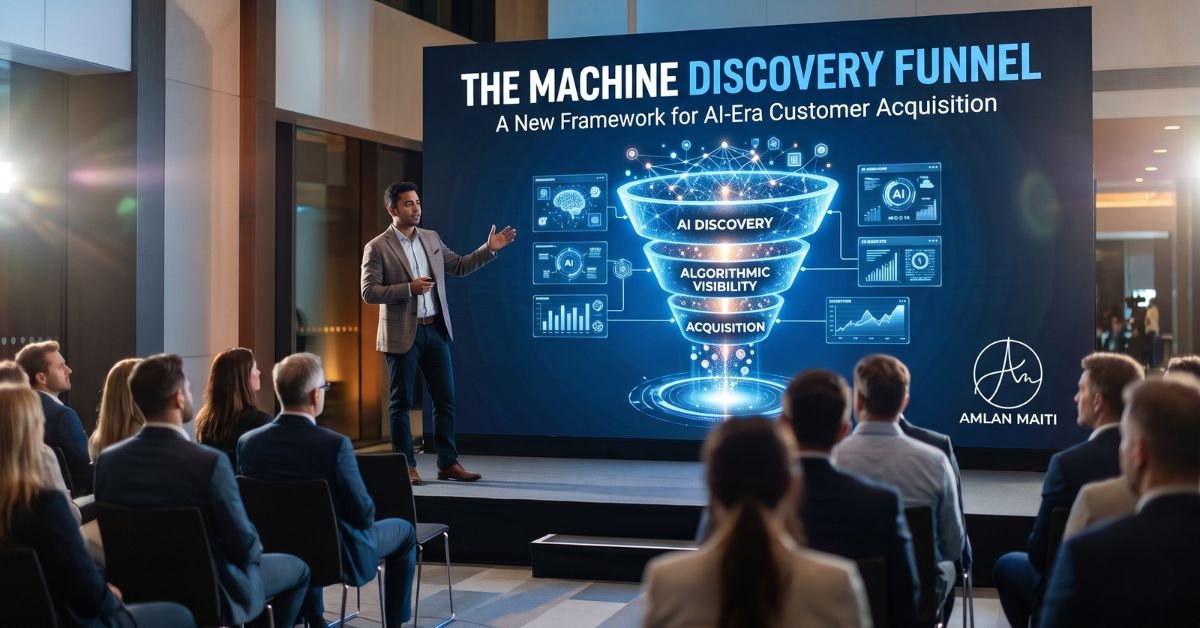
Introducing the Machine Discovery Funnel
The Machine Discovery Funnel is a proposed framework for understanding how a business becomes discoverable and selectable in an AI-mediated customer journey. It focuses on the signals that help digital systems interpret a brand and the experiences that help people trust it.
The framework has five connected stages:
- Signal: The brand has accurate, accessible information across its website and relevant digital sources.
- Understanding: AI systems can interpret what the company does, who it serves, and how its offerings relate to a customer’s need.
- Consideration: The brand becomes a relevant candidate when a user asks for solutions, comparisons, or recommendations.
- Validation: The buyer checks evidence such as reviews, case studies, pricing, credentials, and product details.
- Selection: The buyer takes action, whether that means contacting sales, requesting a quote, booking a service, or purchasing.
These stages are not a rigid sequence. A buyer might return to validation, ask another question, or discover a new competitor halfway through the process. The funnel is best treated as a planning model—not a claim that every AI system follows the same internal process.
Stage One: Signal — Make Your Brand Legible
Before a brand can be considered, its information needs to be accessible and reasonably consistent. If a company describes itself as a software provider on one page, a marketing consultancy on another, and a general business services firm elsewhere, its identity becomes harder to interpret.
Start with the basics. Make your business name, services, locations, product details, and contact information clear. Important pages should be crawlable, useful, and easy to navigate. Structured data can help describe certain facts in a standardized format, but it should accurately reflect visible website content.
For example, a Dubai-based accounting firm should clearly explain whether it provides bookkeeping, tax support, audit services, or financial consulting. Specific information gives people and search systems a better understanding of the business than broad claims such as “complete financial solutions.”
Stage Two: Understanding — Explain Your Relevance
Being identifiable is only the beginning. A business also needs to communicate why it is relevant to particular customer problems.
Imagine a buyer asking, “Which marketing providers can help a B2B company generate qualified leads through AI search?” A company that publishes detailed information about lead generation, search visibility, conversion strategy, and B2B marketing has a clearer topical connection than one whose website merely lists “digital marketing” as a service.
This is where entity relationships, contextual content, and subject expertise become important. Your website should connect the company with the services it genuinely offers, the industries it understands, and the problems it can solve.
For an AI SEO expert in Dubai, the opportunity is to make expertise understandable through practical explanations, relevant examples, and clear service information—not simply to repeat the phrase across multiple pages.
Stage Three: Consideration — Become a Relevant Candidate
In traditional search, a business often measures consideration through impressions, rankings, and website visits. In AI discovery, a user may compare providers inside a conversational interface before clicking anywhere.
The brand’s challenge is to be a suitable candidate for the user’s actual question. That means providing information that answers comparison-oriented needs: who the service is for, what makes it different, what limitations apply, and how the buyer can evaluate it.
Useful content at this stage includes:
- Detailed service pages that explain scope, process, and intended customer fit.
- Comparison guides that discuss meaningful differences without making unsupported competitor claims.
- Case studies that show the starting problem, approach, and documented outcome.
- Expert articles that answer specific questions buyers ask before choosing a provider.
AI recommendations are not guaranteed by publishing these assets. But they create a stronger information base for discovery systems and prospective customers to evaluate.
Stage Four: Validation — Give Buyers Reasons to Trust You
A recommendation may introduce a brand, but it rarely removes the need for due diligence. Buyers still want to know whether the company is credible, experienced, responsive, and suitable for their needs.
This stage is especially important for high-value services. A business considering a digital transformation project may examine team expertise, implementation timelines, technical capabilities, client references, and ongoing support. A consumer buying a product may look for reviews, return policies, warranty information, and product specifications.
Brands should make validation straightforward. Keep testimonials authentic, publish verifiable case studies, explain processes transparently, and ensure that important claims are supported by evidence. Reviews and third-party references can provide useful context, but they should never be manipulated or presented as guaranteed AI ranking signals.
Stage Five: Selection — Turn Discovery Into Action
Once a buyer has formed a shortlist, the next step should be obvious. A confusing website, vague pricing information, or a difficult contact process can undo the value of strong discovery visibility.
Make the action appropriate to the customer journey. Someone comparing providers may need a consultation or a detailed proposal. A ready-to-buy customer may prefer transparent pricing and a direct checkout. A local service customer may simply want to call or book an appointment.
Selection also depends on the quality of the experience after the click. Pages should load reliably, forms should be simple, and the information promised in an AI answer should match what the visitor finds on the website.
How to Measure the Machine Discovery Funnel
One challenge is that traditional analytics may not capture every early-stage AI interaction. A buyer can research a brand in a chatbot, then arrive through a direct visit or branded search. The final session does not reveal the whole story.
Businesses can develop a more useful measurement approach by combining several indicators:
- Discovery signals: Branded search trends, relevant external mentions, AI referral traffic where identifiable, and visibility checks for important customer questions.
- Consideration signals: Visits to comparison pages, service-page engagement, case-study views, and repeat visits.
- Validation signals: Reviews, consultation requests, pricing-page engagement, and interactions with proof points.
- Selection signals: Qualified leads, completed purchases, booked appointments, and sales conversion rates.
- Business outcomes: Customer acquisition cost, revenue quality, retention, and customer lifetime value.
These metrics should be interpreted together. A rise in AI referral visits may be interesting, but qualified opportunities and profitable customers matter more. Similarly, a brand may influence discovery without receiving a directly identifiable click.
How Marketing Teams Can Put the Framework to Work
The Machine Discovery Funnel is most useful when it connects content, technical SEO, reputation, analytics, and conversion optimization. It should not become another disconnected dashboard or a checklist of AI tricks.
Begin by mapping the questions customers ask at each stage. Then review whether your digital presence provides clear, accurate answers. Identify gaps in brand information, service explanations, proof, and conversion pathways. Prioritize the gaps that prevent a buyer from understanding or trusting the business.
Finally, test the framework against real customer journeys. Ask sales teams what prospects already know before contacting them. Review enquiry quality. Compare the questions visitors ask with the information available on your website. These practical observations can reveal where the funnel is leaking—even when analytics cannot show the entire AI conversation.
Frequently Asked Questions
1. What is the Machine Discovery Funnel?
It is a proposed customer acquisition framework for AI-mediated discovery. It describes how a brand moves from accessible information and clear identity to relevance, buyer validation, and eventual selection.
2. Is the Machine Discovery Funnel replacing the traditional marketing funnel?
No. It complements the traditional funnel by emphasizing AI-mediated discovery and the signals that help systems and buyers understand a brand. Awareness, consideration, conversion, and retention remain useful marketing concepts.
3. How can a business improve its visibility in AI discovery?
Make brand and service information clear, publish helpful and specific content, maintain accurate business details, earn genuine third-party references, and provide evidence that supports important claims. No single tactic guarantees inclusion in AI answers.
4. How should businesses measure AI-era customer acquisition?
Combine discovery indicators, engagement, validation activity, qualified leads, conversions, and customer value. Track AI referrals when available, but also consider branded search and customer feedback because early discovery may not produce a directly identifiable click.
Final Thoughts: Design for Discovery and Trust
The AI-era customer journey is not simply shorter; it is changing where understanding and evaluation happen. The Machine Discovery Funnel gives businesses a way to think beyond rankings and clicks, focusing instead on becoming clear, relevant, credible, and easy to choose. The goal is not to persuade a machine at any cost. It is to build a digital presence that helps both systems and people make sense of your value.
Blog Development Credits
Conceptualized by Amlan Maiti, this article was researched and drafted with AI assistance, then refined and optimized for search by Digital Piloto Private Limited.
Related Articles
22 November 2026
The Semantic Trust Architecture: A New Foundation for Generative Search Visibility
Generative search is changing how people discover and evaluate businesses. Instead of simply scanning a page of links, users increasingly…
20 November 2026
Beyond Local Rankings: Becoming the Preferred Business in AI Recommendations
Ranking in local search is valuable, but visibility alone does not guarantee that customers will choose your business. As people…
19 November 2026
AI-Powered Review Intelligence: Understanding Customer Sentiment at Scale
Every customer leaves clues. A short review, a frustrated comment, or a five-star message can reveal what people value, where…

Get In Touch
Initiate your digital marketing journey by filling out this form.