



Recent Post
- A Practical Guide to Calculating SEO Return on Investment in 2027
- How AI-Powered Marketing Turns Traffic Into Revenue and Measurable ROI
- Zero-Click Search in 2027: How Brands Can Stay Visible When Users Skip Search Results
- Recommendation SEO: Optimizing Brands for AI-Driven Discovery and Personalized Recommendations
- From Keywords to Knowledge Graphs: How Search Optimization Continues to Evolve
- Tracking GEO Metrics as AI Search Answers Change Over Time
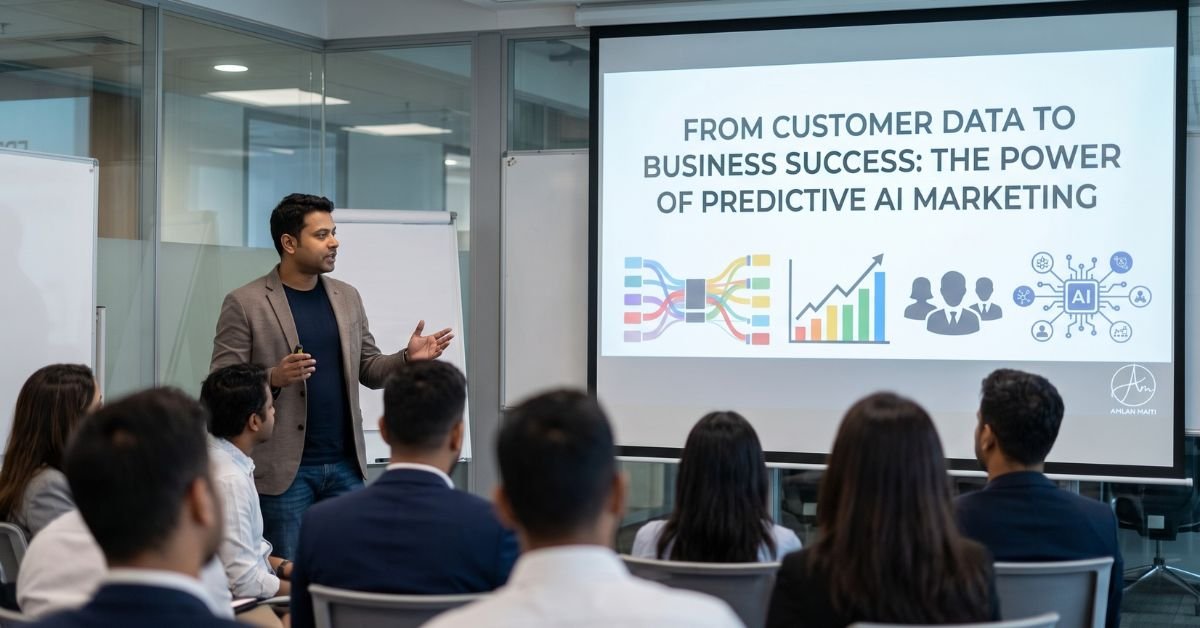
Every customer leaves clues about what they might need next. A product viewed repeatedly, a subscription nearing renewal, or a sudden change in buying habits can reveal opportunities before a customer makes a decision. Predictive AI marketing helps businesses interpret these signals, anticipate likely outcomes, and create more relevant experiences without relying entirely on guesswork.
For businesses looking to turn customer information into measurable growth, predictive marketing offers a practical starting point. An experienced AI SEO expert in Mexico can also help connect customer intent, search behavior, and content strategy, allowing brands to understand what audiences may be looking for before they actively enquire. The real opportunity lies in using data thoughtfully, not simply collecting more of it.
What Is Predictive AI Marketing?
Predictive AI marketing uses historical data, statistical models, and machine learning to estimate what customers may do in the future. Depending on the available information, a system might predict which leads are more likely to convert, which customers could stop buying, or which products may interest a particular audience.
Think of it as a weather forecast for business decisions. A forecast cannot promise exactly what will happen, but it can help people prepare for likely conditions. Similarly, predictive models identify patterns that support better marketing choices, although their predictions are never guaranteed.
Common applications include:
- Lead scoring: Estimating which prospects are most likely to become customers.
- Customer churn prediction: Identifying customers who may discontinue a service or stop purchasing.
- Product recommendations: Suggesting items based on relevant customer behavior and preferences.
- Demand forecasting: Estimating future interest to support campaign and inventory planning.
- Customer lifetime value prediction: Estimating the potential long-term value of customer relationships.
These applications help marketing teams prioritize attention. Instead of sending every customer the same message, a business can develop more relevant communications based on patterns in its data.
Why Customer Data Is the Foundation
Artificial intelligence is only as useful as the information and assumptions behind it. A company may invest in sophisticated software, but if its customer records are incomplete, outdated, or disconnected, the resulting predictions can be misleading.
Useful data may come from website interactions, purchase histories, customer relationship management (CRM) systems, email engagement, customer support conversations, and previous campaign results. Each source reveals a different part of the customer journey.
For example, a customer who visits a pricing page several times, downloads a product guide, and requests a demonstration may be showing stronger purchase intent than someone who visits a homepage once. That does not prove a purchase will happen, but it gives the sales team a more informed basis for deciding when to follow up.
Before building predictive models, businesses should establish clear data practices:
- Remove duplicate records and correct inaccurate customer information.
- Connect relevant data sources while respecting consent and access permissions.
- Define what success means, such as qualified leads, repeat purchases, or reduced churn.
- Review whether the available data represents the customers the business wants to serve.
Privacy deserves particular attention. The US Federal Trade Commission’s business guidance on privacy and security outlines considerations for handling consumer information responsibly. Companies should also follow the privacy laws applicable to their customers and markets, rather than assuming that all data can be used for any marketing purpose.
How Predictive AI Improves Marketing Decisions
1. Finding leads with stronger buying intent
Sales teams often spend valuable time contacting prospects who are not ready to buy. Predictive lead scoring can help rank prospects according to patterns associated with previous conversions.
A software company, for instance, might discover that prospects who attend a product demonstration and explore implementation documentation are more likely to become customers. Its model can use these patterns to help sales representatives prioritize follow-ups.
The score should guide judgment, not replace it. A promising lead may have an unusual buying journey, while a high-scoring prospect may lack the budget or authority to purchase. Human review remains essential.
2. Creating more relevant customer experiences
Personalization becomes more useful when it reflects a customer’s likely needs rather than simply inserting their first name into an email. Predictive models can help determine which product categories, content topics, or offers may be relevant to different customer groups.
Imagine an online retailer noticing that a customer regularly buys home-office accessories. Instead of promoting unrelated products, it might highlight compatible desk organizers or monitor stands. The recommendation is more helpful because it follows a meaningful pattern.
Still, relevance requires restraint. Repeatedly targeting customers based on sensitive or overly personal inferences can feel intrusive. Predictive personalization should make the experience easier, not leave customers wondering how a brand knows so much about them.
3. Reducing customer churn
Winning a new customer is only one part of growth. Businesses also need to recognize when existing customers may be losing interest.
A subscription business might identify patterns such as declining product usage, fewer logins, unresolved support issues, or missed renewal milestones. A predictive model can flag accounts that may need attention, giving the customer success team time to offer assistance.
The best response is often practical rather than promotional. A helpful onboarding session, a solution to a recurring problem, or a clear explanation of an underused feature may rebuild trust more effectively than an automatic discount.
Building a Predictive Marketing Workflow
Predictive AI marketing works best when it is connected to everyday business processes. A prediction that sits in a dashboard and never changes a decision has little commercial value.
A straightforward implementation can follow five steps:
- Choose a business problem. Begin with one measurable goal, such as improving lead qualification or reducing subscription cancellations.
- Prepare the data. Identify the relevant sources, clean the records, and establish appropriate permissions.
- Build and test the model. Compare predictions with real outcomes and test performance on data that was not used to train the model.
- Connect predictions to an action. Decide what happens when a lead receives a high score or a customer shows signs of disengagement.
- Monitor and improve. Review accuracy, business impact, customer feedback, and changes in behavior over time.
Start small. A focused pilot with a clear baseline is generally more informative than introducing AI across every marketing channel at once. The objective is to learn whether predictive insights improve decisions in a measurable way.
Measuring Business Success Beyond Clicks
A predictive model can appear impressive while delivering little commercial value. For that reason, businesses should measure both model performance and marketing outcomes.
Useful metrics may include lead-to-customer conversion rate, customer retention, campaign return on investment, repeat purchase rate, cost per qualified lead, and revenue per customer. Model evaluation may also include precision, recall, calibration, or other measures appropriate to the task.
Compare results against a meaningful baseline. Where practical, controlled experiments can help determine whether predictive targeting actually caused an improvement rather than merely identifying customers who were already likely to buy.
For example, if a churn model identifies customers at risk, a business could compare an intervention group with a suitable control group. If the intervention improves retention without creating excessive discounts or customer complaints, the approach may be worth expanding.
Challenges Businesses Should Not Ignore
Predictive AI is powerful, but it is not a shortcut around sound strategy. Customer preferences change, buying patterns shift, and a model trained on yesterday’s behavior may become less reliable tomorrow.
There are several risks to manage:
- Biased predictions: Historical data may reflect past inequalities or exclude important customer groups.
- Overconfidence: A probability is an estimate, not a promise about an individual’s behavior.
- Fragmented systems: Disconnected CRM, analytics, and campaign platforms can prevent insights from reaching the right teams.
- Privacy concerns: Unclear data practices can damage trust and create legal exposure.
Review model performance regularly, explain automated decisions where appropriate, and give employees a clear way to challenge questionable recommendations. The most effective system combines machine intelligence with human accountability.
Frequently Asked Questions
1. What is predictive AI marketing used for?
It helps businesses estimate customer behavior, prioritize leads, forecast demand, personalize recommendations, identify churn risks, and plan campaigns using patterns in historical and current data.
2. Does predictive AI marketing work for small businesses?
Yes. Small businesses can begin with existing CRM records, purchase history, website analytics, and email engagement data. A focused use case and reliable data are more important than purchasing a complex AI platform immediately.
3. Is predictive marketing the same as personalization?
No. Predictive marketing estimates likely outcomes or future needs. Personalization adapts content, offers, or experiences to a customer. Predictive insights can improve personalization, but the two approaches are not identical.
4. How can businesses measure predictive marketing ROI?
Track relevant outcomes such as conversion rates, retention, qualified leads, campaign profitability, and customer lifetime value. Compare performance with a baseline or control group when possible to determine whether the predictive approach created meaningful improvement.
Final Thoughts: Turn Signals into Smarter Decisions
Predictive AI marketing helps businesses move from reacting to customer behavior toward preparing for likely needs. Its real strength is not the promise of perfect forecasts, but the ability to make everyday decisions more informed. Begin with clean data, a clearly defined objective, and responsible measurement. When predictive insights lead to genuinely better customer experiences, business growth becomes a more achievable outcome.
Blog Development Credits
Conceptualized by Amlan Maiti, this article draws on research and AI-assisted drafting, with final SEO refinement by Digital Piloto Private Limited.
Related Articles

21 October 2026
A Practical Guide to Calculating SEO Return on Investment in 2027
SEO can bring more visitors to your website, but traffic alone does not pay the bills. What matters is whether…

19 October 2026
How AI-Powered Marketing Turns Traffic Into Revenue and Measurable ROI
Getting thousands of website visitors feels encouraging, until the sales report tells a different story. Why do some visitors buy…

18 October 2026
Zero-Click Search in 2027: How Brands Can Stay Visible When Users Skip Search Results
What happens when someone searches for your business category, gets an instant answer, and never visits a website? For brands,…

Get In Touch
Initiate your digital marketing journey by filling out this form.